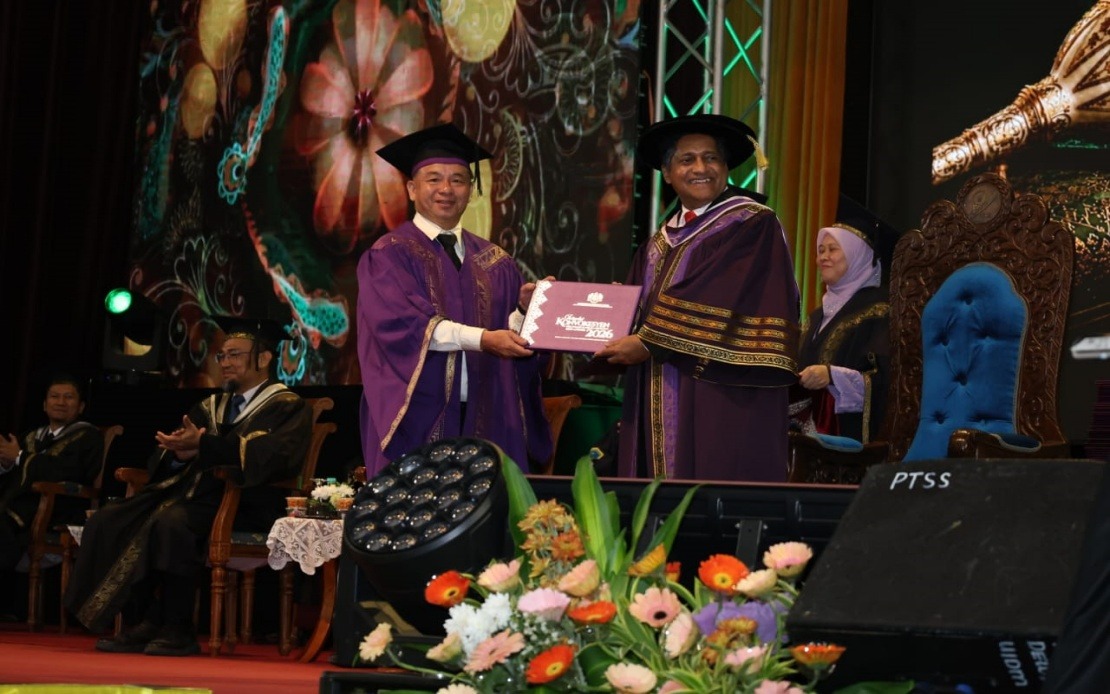
At 57 years old, Heng Meng Lai has shattered the conventional timeline of educational achievement by becoming the oldest graduate in Seberang Perai Polytechnic's history. His completion of the Diploma in Electrical and Electronic Engineering at the PSP Convocation Ceremony 2026 represents far more than a personal milestone—it embodies a powerful statement about lifelong learning and the democratisation of educational opportunity that remains relevant across Malaysia and Southeast Asia.
Heng's educational journey was anything but linear. Deferred for nearly five decades due to the competing demands of work and family responsibilities, his pursuit of formal qualification reflects the reality faced by countless Malaysians whose life circumstances once forced them to abandon academic ambitions in favour of immediate survival. His story resonates particularly in a nation where many individuals from lower socioeconomic backgrounds have historically had to choose between education and putting food on the table.
The circumstances that shaped Heng's early life provide crucial context for understanding his determination. As the third of seven siblings, he witnessed his mother's struggle to keep the family afloat after his father's death when Heng was just nine years old. Working in a sewing factory, his mother exemplified the resilience that would later define her son's approach to his own challenges. Rather than allowing early hardship to extinguish his aspirations, Heng channelled those experiences into motivation for self-improvement, a trajectory that eventually led him back to the classroom decades later.
What makes Heng's achievement particularly noteworthy is not merely the completion of his studies, but the deliberate choice of his field. His selection of Electrical and Electronic Engineering was rooted in genuine professional experience and sustained curiosity rather than abstract career planning. His background working as a storekeeper and later as a production line supervisor at an electronics factory had kindled a deeper fascination with the technical and engineering dimensions of the industry. This career progression demonstrates how practical work experience, when coupled with intellectual inquiry, can provide a meaningful foundation for formal education at any stage of life.
The support systems that facilitated Heng's success merit particular attention. His accounts of receiving patient guidance and continuous encouragement from PSP's lecturers highlight the crucial role that institutional culture plays in enabling non-traditional students to thrive. Many mature students report feelings of alienation or invisibility in educational environments dominated by younger peers. That Heng felt genuinely integrated into the learning community, never experiencing marginalisation despite being substantially older than his classmates, speaks volumes about the inclusive pedagogical approach PSP has cultivated—a model other Malaysian polytechnics and educational institutions would be wise to examine and potentially replicate.
From a broader policy perspective, Heng's achievement arrives at a significant moment in Malaysia's educational landscape. The government has increasingly emphasised the concept of lifelong learning as essential to developing a skilled, adaptable workforce capable of navigating rapid technological change. Heng's story provides a compelling real-world illustration of how this principle translates into practice. His willingness to acquire new qualifications at an age when many would consider their career trajectory fixed demonstrates the untapped potential within Malaysia's existing workforce—individuals with decades of practical experience who possess both the capability and motivation to upgrade their formal credentials.
The implications of Heng's achievement extend into labour market dynamics as well. As Malaysia faces skills shortages in critical sectors including electrical engineering and electronics manufacturing, drawing on the human capital already present in the workforce through upskilling programmes offers a pragmatic solution. Heng's successful transition from production line supervisor to diploma-qualified engineer represents exactly the kind of internal talent pipeline development that can address skills gaps without relying solely on new graduates or international recruitment.
Looking forward, Heng has articulated ambitious plans to apply his newly acquired knowledge and skills in the workplace before pursuing further advancement through a bachelor's degree. This staged approach to continuing education reflects realistic self-awareness and demonstrates that his motivation extends beyond securing a single credential. Instead, he envisions education as an ongoing process of personal and professional development—a mindset increasingly valuable in sectors prone to technological disruption and evolution.
Mohd Ruzi Hamzah, PSP's director, appropriately contextualised Heng's achievement within the institution's broader mission and Malaysia's national educational aspirations. By characterising Heng's journey from storekeeper to production supervisor to diploma holder as evidence that education constitutes a universal right rather than a privilege confined to a particular life stage, PSP's leadership articulated a vision of educational equity that demands systemic recognition. The institution's commitment to serving all demographic segments regardless of age or background positions it as a model for addressing educational inequality and expanding access within the polytechnic sector.
Heng Meng Lai's story ultimately transcends the narrative of individual triumph, though his personal perseverance certainly deserves recognition. More importantly, it illuminates the potential that exists when institutions commit to inclusive pedagogy, when mature individuals are afforded genuine opportunities to pursue qualification, and when educational systems acknowledge that learning has no predetermined expiration date. For Malaysian policymakers and educational administrators, his achievement serves as both inspiration and challenge—inspiration that transformation is possible, and challenge to ensure that the structures and support systems enabling such transformation become universal rather than exceptional.

