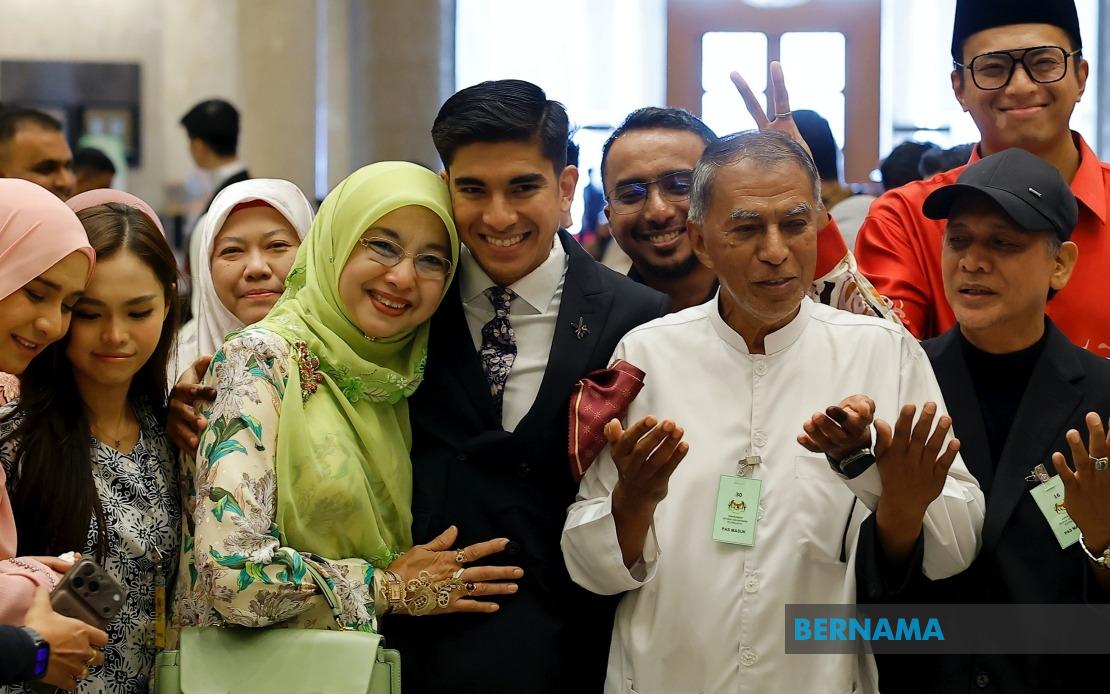
The Federal Court in Putrajaya has brought closure to a six-year legal saga involving Muar Member of Parliament Syed Saddiq Syed Abdul Rahman, upholding his complete acquittal on four charges of abetting criminal breach of trust, misappropriation of property, and money laundering connected to funds belonging to youth movement Angkatan Bersatu Anak Muda (Armada). The resolution, delivered on July 13, represents a watershed moment for the 33-year-old politician, whose case has drawn sustained public attention and raised important questions about Malaysia's prosecutorial and judicial processes.
Following the court's announcement, Syed Saddiq gathered with his family to perform sujud syukur—a prostration of gratitude observed in Islamic tradition—and subsequently addressed media representatives in the Palace of Justice lobby. His remarks underscored a personal conviction that has apparently sustained him through the protracted legal proceedings: that adherence to principle and integrity would ultimately yield vindication. For Malaysian observers, the case exemplifies the lengthy timeline associated with complex white-collar criminal prosecutions navigating Malaysia's tiered court system, from initial investigation through to final federal judicial determination.
The former youth and sports minister characterised the ordeal as transformative, extending its impact beyond his own circumstances to encompass his immediate family, extended network of supporters, and the broader political environment. Six years represents a substantial portion of any individual's career trajectory, particularly for a politician in mid-career who might otherwise have consolidated ministerial experience or strengthened party institutional positions during this period. The extended duration of legal uncertainty creates compounding personal and professional consequences—financial burden, reputational vulnerability, and restricted political mobility—that extend well beyond the formal verdict itself.
In his public statement, Syed Saddiq articulated a philosophical perspective on institutional trust that resonates within Malaysia's ongoing national conversation about governance accountability and judicial integrity. He emphasised that even when circumstances appear insurmountable or institutional pathways blocked, maintaining core principles, personal integrity, and dignity takes precedence over expedient compromise or plea arrangements that might achieve faster nominal resolution. This position implicitly argues for confidence in Malaysia's appellate mechanisms and constitutional safeguards, positioning them as foundations upon which national strength ultimately rests. For regional observers tracking Southeast Asian institutional development, such affirmations from public figures subjected to criminal proceedings carry weight in assessing elite confidence in judicial independence.
Datuk Hisyam Teh Poh Teik, the lead counsel in the case, formalised the defence team's gratitude toward both the judicial panel and their client's sustained confidence throughout the proceedings. The lawyer's acknowledgment of the judges' decision and appreciation for family trust underscores the collaborative nature of successful appellate defence, requiring not merely legal expertise but sustained client commitment across multiple court levels. The Federal Court panel's composition and reasoning—though not detailed in available reporting—will likely inform subsequent legal scholarship examining criminal procedure, evidence standards, and prosecutorial burden in cases involving financial impropriety allegations.
The Office of the Deputy Public Prosecutor, represented by Datuk Wan Shaharuddin Wan Ladin, confirmed that prosecutors have accepted and respect the court's determination. Significantly, the prosecution has not yet committed to seeking a review of the Federal Court's judgment, indicating procedural circumspection about pursuing further appellate avenues. The statement that the Attorney General's position remains pending suggests the prosecution maintains theoretical options but faces substantive and strategic considerations counselling against protracted re-litigation. In the Malaysian legal context, such prosecutorial statements carry institutional weight, potentially signalling that the case has reached genuine finality rather than representing one waypoint in prolonged adversarial cycling.
Syed Saddiq has signalled an intention to temporarily withdraw from the intensified demands of partisan political activity, prioritising restoration of personal and family relationships following years of legal preoccupation. However, he emphasised continued affiliation with MUDA—the political movement he helped establish—and indicated intention to maintain parliamentary obligations as Muar's elected representative. This differentiation between party loyalty and temporary political dormancy suggests strategic recalibration rather than complete political retirement, preserving institutional positioning whilst permitting psychological recovery and domestic consolidation.
The politician also referenced approval from his parents to proceed with previously deferred wedding plans, indicating that resolution of his criminal liability constitutes a necessary precondition for major personal life milestones. This detail humanises the procedural battle, illustrating how prolonged legal uncertainty cascades into disrupted personal trajectories affecting family formation, financial planning, and domestic stability. For Malaysian readers, such personal consequences underscore the broader societal costs attending lengthy criminal proceedings, irrespective of ultimate vindication outcomes.
The acquittal and its Federal Court reaffirmation carry implications extending beyond Syed Saddiq's individual circumstances into Malaysia's political and institutional landscape. The case involves allegations concerning youth movement funding mechanisms—territory frequently contentious in Malaysian political practice, where financial flows between political entities and youth wings attract regulatory and investigative scrutiny. That the Federal Court has thoroughly exonerated Syed Saddiq on all charges suggests either prosecutorial overreach in initial charges, substantive evidential insufficiency at appellate review stages, or legal interpretations favourable to the defence characterisation of the facts.
From a Southeast Asian comparative perspective, Malaysia's completion of appellate resolution in this case—despite the extended timeline—demonstrates functional capacity of the Federal Court to deliver definitive resolution on serious financial crime allegations involving political figures. This contrasts sharply with numerous regional jurisdictions where analogous cases either languish in preliminary proceedings indefinitely or encounter sustained political obstruction of judicial processes. The institutional integrity associated with permitting complete acquittal regardless of initial prosecutorial momentum provides important signals about judicial independence and appellate willingness to scrutinise lower court determinations rigorously.
Syed Saddiq's emphasis on defending the independence of Malaysia's justice institutions frames his personal exoneration within a broader institutional advocacy project. He explicitly positions judicial autonomy as foundational to national strength, a framing that acknowledges current challenges to institutional confidence whilst positioning the acquittal as evidence that principled adherence to institutional procedures ultimately yields fair outcomes. For Malaysian readers navigating ongoing political-judicial tensions, such reaffirmations—emerging from someone who has experienced the system's substantive operation from within criminal jeopardy—carry particular resonance.
The closure of this six-year legal episode marks a threshold for Syed Saddiq's political career trajectory and personal restoration. Whilst the acquittal vindicates his position categorically, the years-long legal burden has necessarily altered the political landscape he seeks to re-engage with, particularly regarding youth movement positioning within Malaysian politics and questions surrounding financial accountability mechanisms within political entities. His subsequent political role and influence will substantially depend upon how effectively he rehabilitates public perception and reconstructs political momentum following extended prosecutorial focus and public legal scrutiny.

