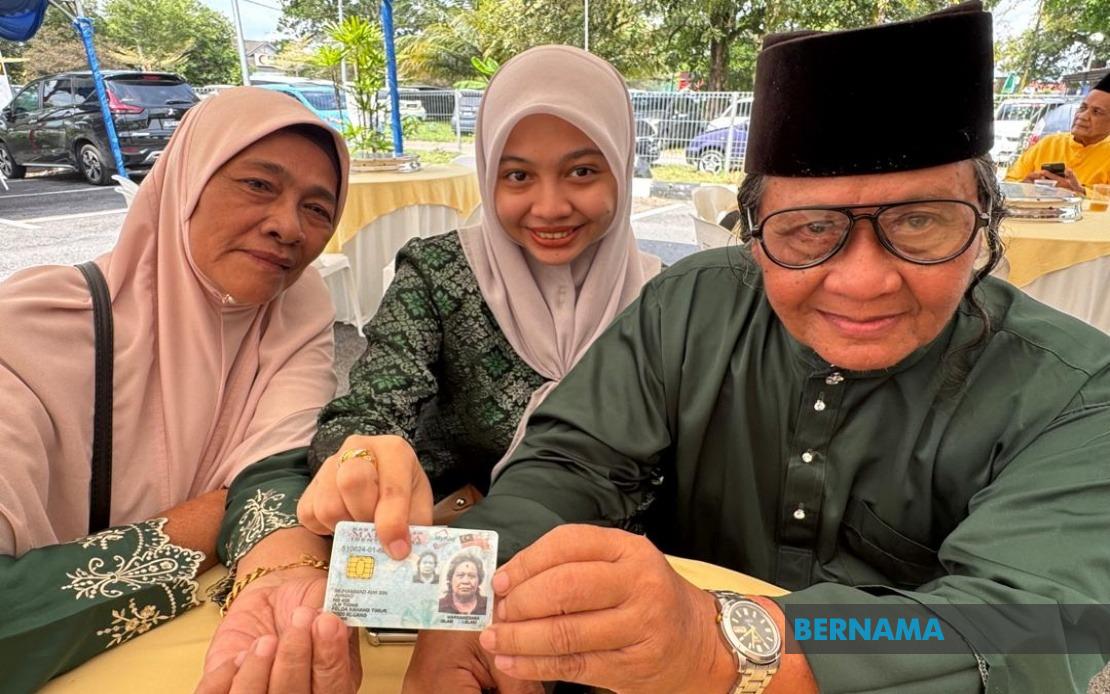
Muhammad Awi Ahmad's 75th birthday proved momentous for reasons extending far beyond a personal milestone. The Felda Kahang Timur settler received his land ownership title on the day he turned three-quarters of a century old—a symbolic convergence that underscores both the extended wait and the profound relief felt across Johor's plantation communities. Having cultivated nearly 4.2 hectares since 1986, Muhammad Awi had pursued formal ownership through three separate applications spanning three decades, with initial rejections in 1990 and 2000 leaving him in prolonged uncertainty about his family's future security.
The Johor Felda Settlers Land Title Handover Ceremony, conducted at Dewan Dato' Onn in Kluang, represented a watershed moment for communities stretched across multiple districts. The event recognised 210 recipients from Kluang, Kota Tinggi and Mersing, yet this visible gathering marked only a fraction of a much larger resolution. Menteri Besar Datuk Onn Hafiz Ghazi's administration completed the approval process in approximately one year—a striking acceleration compared to the two decades many settlers had endured previously. The government's shift in pace suggests not merely procedural efficiency but a deliberate commitment to resolving what had become an increasingly urgent intergenerational concern.
The human dimension of this land rights question extends beyond first-generation settlers like Muhammad Awi. His daughter Norliyani, representing the second wave of Felda families, articulated a perspective often overlooked in land administration discussions. Unlike her father's generation, who retained theoretical options to return to their villages of origin, those born into settlement communities regarded Felda as home with no realistic alternatives. For young adults inheriting cultivated land without legal claim, the vulnerability proved acute. Norliyani emphasised that unresolved ownership titles risked displacing property rights to outsiders entirely, severing the connection between generations of labour and tangible family assets.
Mohd Farhan Mohamad's experience illustrated another temporal dimension of this struggle. His initial 2006 application, motivated by his father Mohamad Masek's desire to formalise decades of stewardship since the 1980s, languished in bureaucratic channels for nearly eighteen years. The subsequent approval in 2023—following a fresh application the previous year—speaks to administrative transformation rather than sudden discovery of dormant applications. These timelines reveal systemic bottlenecks that affected thousands simultaneously, creating generational anxiety about wealth, inheritance and familial continuity across Felda territories.
The statistics underlying the Johor initiative demonstrate remarkable completion rates. Approximately 27,639 out of 27,642 Felda settlers in the state who submitted applications have now received formal ownership titles—a 99.9 per cent success rate that suggests either exceptionally thorough processing or, conversely, the absence of genuine disputes. This near-universal approval pattern differs markedly from the previous decades when applications faced systematic rejection. The shift implies either that earlier rejections rested on procedural rather than substantive grounds, or that administrative criteria have been substantially revised to facilitate rather than obstruct settler claims.
The broader implications for Felda communities across Malaysia extend beyond symbolic justice. Land ownership titles constitute collateral essential for agricultural financing, inheritance planning and economic mobility. For families whose primary asset consists of plantation land, formalised ownership unlocks banking relationships, enables productive investment, and provides security against administrative capriciousness. In Southeast Asian contexts where informal land tenure remains widespread, Malaysia's move toward regularising settler claims establishes precedent for protecting smallholder communities against tenure insecurity.
The intergenerational dimension warrants particular emphasis for policymakers. Norliyani's commentary highlighted how unresolved first-generation claims cascade through subsequent generations, creating compounding vulnerability. Children and grandchildren inherit no usable title to property they occupy and work, leaving them simultaneously impoverished and immobilised. By addressing settler claims during the first and second generations' productive lifespans, governments create conditions for intergenerational wealth accumulation rather than perpetuating dependency on state management of communal resources.
Johor's acceleration of the approval process—from decades of waiting to approximately one year for recent applications—suggests that institutional will, rather than technical complexity, previously constrained resolution. Whether through additional staffing, simplified documentation requirements, or revised approval criteria, the state government's approach offers a template for other regions managing similar settler populations. The timing also reflects growing political awareness that unresolved land security constitutes a source of rural discontent that governments ignore at electoral peril.
The ceremony's symbolic significance extended beyond individual family circumstances to encompass broader questions of social contract in Malaysia's development model. Felda represented a mid-twentieth-century vision of managed rural development, whereby settled communities would receive land, services and market access in exchange for cultivating cash crops. That this foundational promise required four decades to fully honour suggests institutional misalignment between development intentions and administrative capacity. The current resolution represents not merely delivering on original commitments but also acknowledging accumulated injustice.
For Malaysian policymakers overseeing rural development and land administration, the Johor experience offers instructive lessons about the importance of swift formalisation. Land security matters profoundly for household economic behaviour, agricultural productivity, and social stability. Communities uncertain about property claims typically underinvest in land improvements, avoid productive debt financing, and experience elevated stress-related health and social problems. By contrast, title security incentivises long-term investment and enables intergenerational capital transfer. The Johor Felda programme, once completed, should yield measurable improvements in agricultural productivity, credit access and household wellbeing across beneficiary communities.
Muhammad Awi's birthday gift—arriving after forty-four years of waiting—encapsulates the human cost of administrative delay. Yet his story concludes positively, offering hope to remaining settlers in other regions still awaiting formalisation of their claims. The comprehensive nature of Johor's programme, encompassing 27,639 families, suggests that technological and administrative capacity now exists throughout Malaysia to regularise settler tenure relatively efficiently. Whether other Felda territories and state governments will mobilise comparable resources and political will remains an open question, but Johor has demonstrated that the principal constraint lies not in capability but in commitment.

