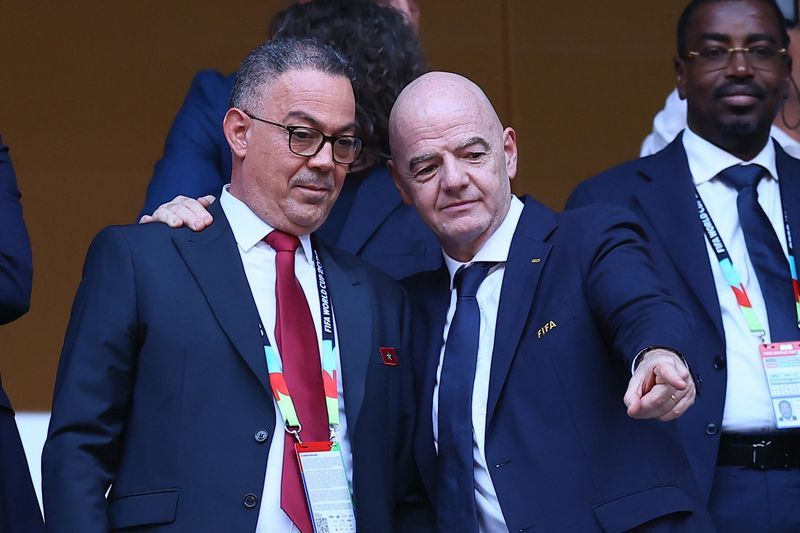
FIFA President Gianni Infantino's political future hinges significantly on African support, with leading administrators across the continent now offering public endorsement as he navigates mounting pressure from rivals and competing regional interests. The backing comes at a strategically vital moment, as Infantino faces his re-election campaign heading toward March 2026, with other major football confederations having already signalled their loss of confidence in his leadership.
Five influential African football figures have released statements expressing their support for Infantino while simultaneously welcoming his decision to abandon a controversial scheme aimed at generating $4.2 billion through the creation of a new commercial rights body. These messages of solidarity represent a crucial lifeline for the embattled FIFA chief, who faces an increasingly fractious global football community. The endorsements come from CAF Vice President Fouzi Lekjaa of Morocco, Egypt's Hany Abo Rida, Niger's Hamidou Djibrilla, Mauritania's Ahmed Yhaya, and Veron Mosengo-Omba, the recently elected president of the Democratic Republic of Congo's football federation who previously served as CAF general secretary.
The timing of this African backing reflects the continent's distinct position within global football politics. While Asia, Europe, and CONCACAF—the confederation governing North and Central America and the Caribbean—all formally withdrew their confidence in Infantino's leadership over the weekend, the Confederation of African Football has maintained deliberate silence on the matter. This strategic restraint offers Infantino genuine hope that he can mobilise the substantial voting bloc represented by CAF's 54 member nations when he seeks re-election. The contrast with other continents reveals a fundamental difference in how African football leadership calculates its interests and leverage within the FIFA power structure.
The abandoned commercial initiative had triggered intense controversy across the global football establishment before Infantino pulled the plug on Friday, following a week of coordinated pressure from various stakeholders. CAF had initially released only a cautious statement last Wednesday indicating it would study the FIFA Forward Enterprise proposal, a measured response that stood in sharp contrast to the immediate and hostile reactions from other confederations. The divergence in response highlights how African football administrations operate according to different political imperatives than their counterparts in wealthier regions, where institutional stability and governance principles carry more weight than financial considerations.
Financial dependency forms the bedrock of Infantino's enduring appeal to African football administrations. Since his election victory in 2016, largely secured through promises to substantially increase development funding to member associations, Infantino has maintained consistent popularity across the continent by expanding and deepening FIFA's financial support mechanisms. This strategic generosity stands in marked contrast to the approach of his predecessor, when Sepp Blatter first introduced the concept of direct financial assistance to member associations. The baseline FIFA funding now guarantees each of the 211 member associations $8 million over every four-year cycle, while CAF additionally provides annual grants to its members, creating a financial dependency structure that renders African football leaders particularly receptive to Infantino's leadership claims.
The economic pressures facing African football confederations provide essential context for understanding their continued support for Infantino despite controversies troubling other regions. National football associations across the continent struggle with chronic resource scarcity, lacking reliable domestic sponsorship bases or government financial commitments to their operations. Saïd Ali Athouman, president of the Comoros Football Federation, articulates this fundamental imbalance starkly: African nations cannot compete with the financial advantages enjoyed by wealthier countries, where robust national infrastructure, equipment provision, and training facilities represent standard features. The wealthy European nations face no equivalent constraints in fielding competitive teams, while African countries must depend almost entirely on external funding to maintain basic operational capacity.
Malawi's situation exemplifies the desperate resource constraints confronting many African football associations. Fleetwood Haiya, president of the Football Association of Malawi, highlights the impossible choices facing governments in developing nations: adequate medical provision for hospitals takes priority over football infrastructure investment, yet national sporting competitiveness requires stadium development and modern facilities. This fundamental scarcity has created a structural reality where African football administrators view FIFA financial support not as discretionary luxury but as essential life support for their sport's viability. Consequently, they demonstrate considerably greater tolerance for Infantino's controversial governance decisions than administrators in regions where football operates independently of FIFA patronage.
The FIFA Forward programme represents Infantino's deliberate expansion and rebranding of Sepp Blatter's earlier Goal Project initiative. Infantino dramatically increased the financial scale of these distributions, transforming them into a major revenue stream for African member associations. This expansion occurred under the banner of FIFA Forward, positioning the scheme as a modernised successor to Blatter's original concept while simultaneously emphasising Infantino's personal commitment to African football development. The exponential increase in monies distributed through this mechanism created reciprocal political obligations that now anchor African support for Infantino's continued leadership, even as other confederations reassess their positions.
The historical parallel to Sepp Blatter's own election victory provides instructive perspective on African football's voting power within FIFA's governance structure. Blatter triumphed in his 1998 election against Lennart Johansson, then UEFA president, precisely because he secured overwhelming backing from African member associations despite receiving formal endorsement from CAF itself—then led by Johansson. These nations had never previously received financial support from world football's governing body, making Blatter's promise of development assistance a transformative offering. The legacy of that victory established a political template that Infantino has consciously followed: secure African loyalty through targeted financial commitment, thereby guaranteeing a reliable voting bloc when global football politics become contested.
Prior to the World Cup revenue scheme scandal erupted, leading African football figures had already positioned themselves prominently in Infantino's corner. Motsepe, prominent among African football administrators, offered unusually effusive praise for Infantino merely days before the controversial monetisation plan became public. His characterisation of Infantino as both friend and loyal partner to Africa underscores the personal relationships and trust networks that underpin political backing within football governance. Motsepe's invocation of loyalty and reciprocity—the principle that those who have supported you should never face betrayal—reflects an African leadership philosophy that prioritises personal honour and relationship preservation over institutional governance concerns that preoccupy administrators in wealthier regions.
The CAF executive committee meeting scheduled for Thursday would formally discuss the abandoned revenue scheme, yet there remains no certainty that African football's governing body will take any definitive public stance regarding Infantino's broader leadership future. This calculated ambiguity represents strategic positioning by CAF, maintaining leverage by neither fully committing to Infantino nor breaking publicly with him. The approach allows CAF to preserve future negotiating position while its member nations individually signal support, creating political cover that complicates efforts by opposing confederations to mount coordinated campaigns against Infantino's re-election.
The emerging African backing demonstrates how Infantino's financial strategy has effectively restructured global football's political economy. By transforming FIFA's role from regulatory body into major development funder for poorer nations, he created constituencies with powerful incentives to defend his tenure. This stands in stark contrast to wealthy confederations, where football organisations operate with independent revenue streams and view FIFA primarily through governance and institutional reform lenses. African football administrations, by contrast, view FIFA through the lens of essential financial support and development opportunity, a perspective that renders them more politically flexible and more inclined to forgive governance controversies that would prove unacceptable in wealthier regions.
Infantino's strategic cultivation of African support reflects sophisticated understanding of FIFA's internal political dynamics. The 54 African votes represent a substantial bloc within FIFA's membership voting structure, potentially decisive in contested elections where support from wealthy confederations remains fractionalised or uncertain. By securing explicit endorsements from CAF's most influential figures—while maintaining the formal neutrality of CAF itself—Infantino preserves maximum flexibility heading toward next year's presidential election. The continental divisions now emerging suggest that any challenge to Infantino's re-election will require not merely criticism from wealthy confederations but positive alternatives capable of matching or exceeding the financial commitments that have anchored African loyalty to his administration.

