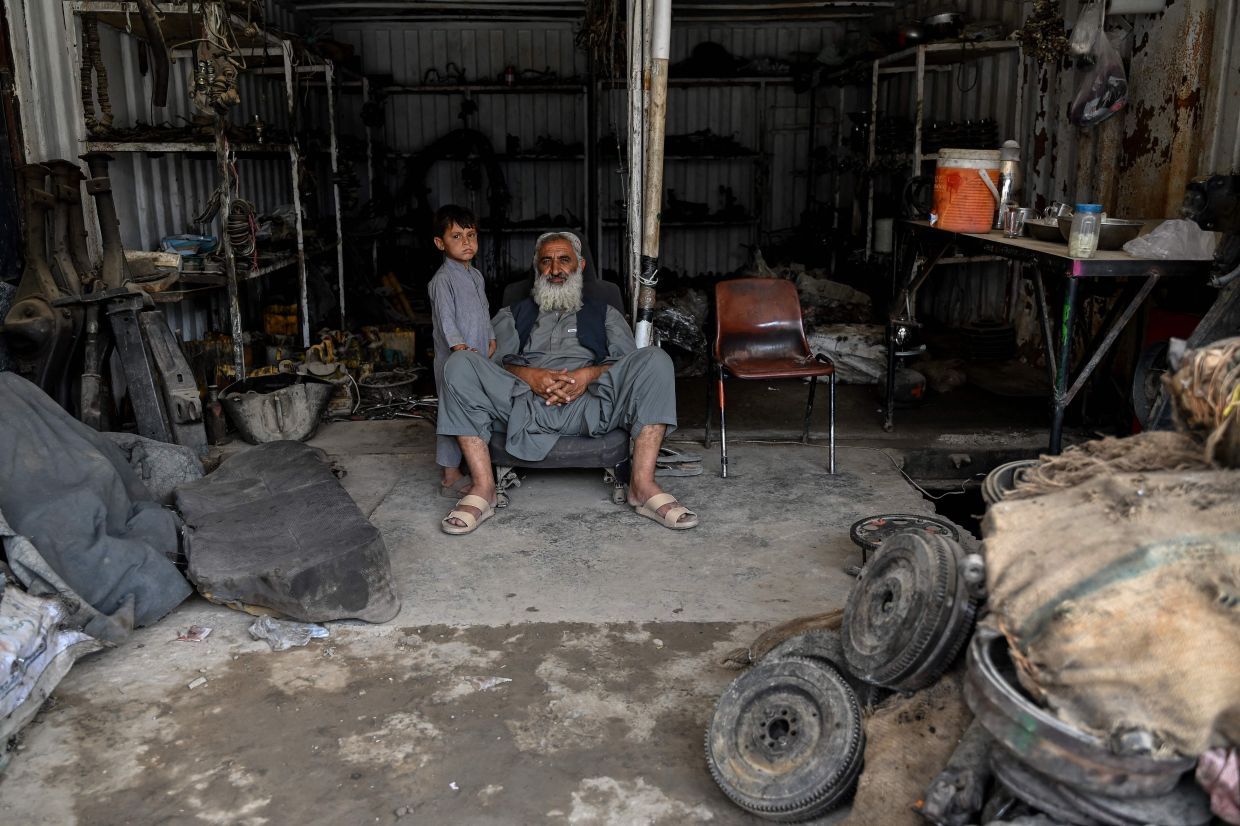
The automotive parts trade that once animated Spin Boldak market in Afghanistan's southern Kandahar province has come to a grinding halt, casualties of overlapping regional conflicts that have choked off traditional supply arteries. What was once a flourishing operation importing components from Japan and other distant manufacturers has been progressively strangled by violence at Afghanistan's borders and instability across international shipping lanes, leaving traders, mechanics, and labourers facing potential destitution.
The first blow struck in October when cross-border skirmishes between Afghanistan and Pakistan prompted authorities to effectively seal the frontier, severing the most direct overland route through which automobile parts traditionally flowed into the country. Traders hastily improvised by redirecting shipments through Iran's Bandar Abbas port, a more circuitous and burdensome alternative, yet one that at least permitted modest commercial activity to persist. Abdul Baqi Bina, deputy head of the Kandahar Chamber of Commerce and Investment, acknowledged that while this workaround proved arduous, it represented the only viable option at that juncture. The costs were substantial, but the trade continued limping forward on this longer, less efficient pathway.
Then February brought geopolitical upheaval in the Middle East, transforming a serious predicament into an existential catastrophe for Afghan traders. The regional conflict triggered unprecedented disruption to maritime traffic through the Strait of Hormuz, one of the world's most critical shipping chokepoints through which vast quantities of international commerce flows annually. Shipping companies have cautioned that normalcy along this vital waterway may take considerable time to restore, leaving Afghanistan's already fragile supply chains in a state of profound uncertainty. For a nation dependent on imports channelled through the United Arab Emirates and neighbouring routes, this disruption proved devastating.
The mathematical reality of these compounding crises is starkly illustrated in container costs. Importers who previously paid approximately US$2,000 per container watched those fees multiply fourfold to US$8,000 following the Middle East conflict's outbreak. One importer named Asadullah, operating from Dubai and Japanese sources, witnessed his business essentially paralysed over recent months. His operation, which once processed roughly two containers daily through the Spin Boldak yard, now sits idle. More than thirty containers remain stranded across Japan and the United Arab Emirates, many halted at Dubai's Jebel Ali port, the critical logistics hub that orchestrates much of Afghanistan's foreign trade.
Another parts importer named Masoud recounts the devastating contraction in his operations. Where his enterprise once handled dozens or even hundreds of containers monthly, volumes have plummeted to zero since the Iran conflict commenced. Containers that successfully navigated to the United Arab Emirates now face prohibitive storage fees that render their retention economically untenable. Rather than absorb mounting costs indefinitely, Masoud has begun shipping containers back to Japanese suppliers, a decision he views as capitulation but as the only rational course given Afghanistan's collapsed market conditions. The enterprise faces complete cessation of revenue with no identifiable alternative pathways for resumption.
The World Bank's May assessment of Afghanistan's economic vulnerability provides sobering context for understanding these commercial disruptions. The institution characterised the nation as exceptionally exposed to external shocks, noting a widening chasm between imports and exports that reached 70 percent of GDP in the 2025 fiscal year. Afghanistan's economy, already fragile and heavily import-dependent, cannot absorb extended disruptions to critical supply chains without suffering profound consequences across employment, consumer prices, and overall stability.
The human dimensions of this commercial collapse extend through thousands of workers whose livelihoods depend on the Spin Boldak market's operations. Mohammad Naeem, a twenty-one-year-old crane operator, faces the prospect of permanent displacement from his profession should conditions fail to improve. The dark workshops where automobiles were assembled now present a melancholy tableau of idle workers surrounded by dormant equipment and silent tools. Samiullah, a workshop proprietor in his thirties, previously oversaw production of five to seven vehicles weekly but now confronts an operation generating zero output due to exhausted parts inventories.
The fixed costs of maintaining these operations create mounting pressure on proprietors who must continue compensating employees regardless of revenue generation. Workshop owners and importers operate with dwindling financial reserves, watching losses accumulate without corresponding income to offset expenses. The mathematics of this situation permits only temporary endurance; prolonged stagnation guarantees business failure and mass redundancy throughout the sector.
Retail dimensions of the collapse are equally apparent at automobile showrooms throughout the Spin Boldak market. Dealers surrounded by inventory built from Japanese-sourced components find customer interest evaporating alongside import flows. Noor Ali, who operates a showroom displaying colourful assembled vehicles, reports minimal sales activity with a month having elapsed since his last transaction. As container arrivals diminish, prospective purchasers disappear, creating a vicious cycle wherein traders cannot move inventory, cannot generate revenue, and cannot sustain operations pending the opening of supply channels.
The resolution to Afghanistan's automotive parts crisis hinges on stability along multiple fronts simultaneously. The Strait of Hormuz must return to reliable operations permitting normalized maritime commerce. Pakistan-Afghanistan border tensions require de-escalation and reopening of this critical overland corridor. Traders express hope, though perhaps forlornly, that political agreements will restore normal passage through these vital conduits. Until such restoration occurs, Afghanistan's automobile sector remains essentially defunct, its workers displaced, its traders bankrupt, and its consumers bereft of vehicle maintenance capacity—collateral damage in conflicts ostensibly unrelated to their immediate interests yet catastrophic in their economic consequences.

