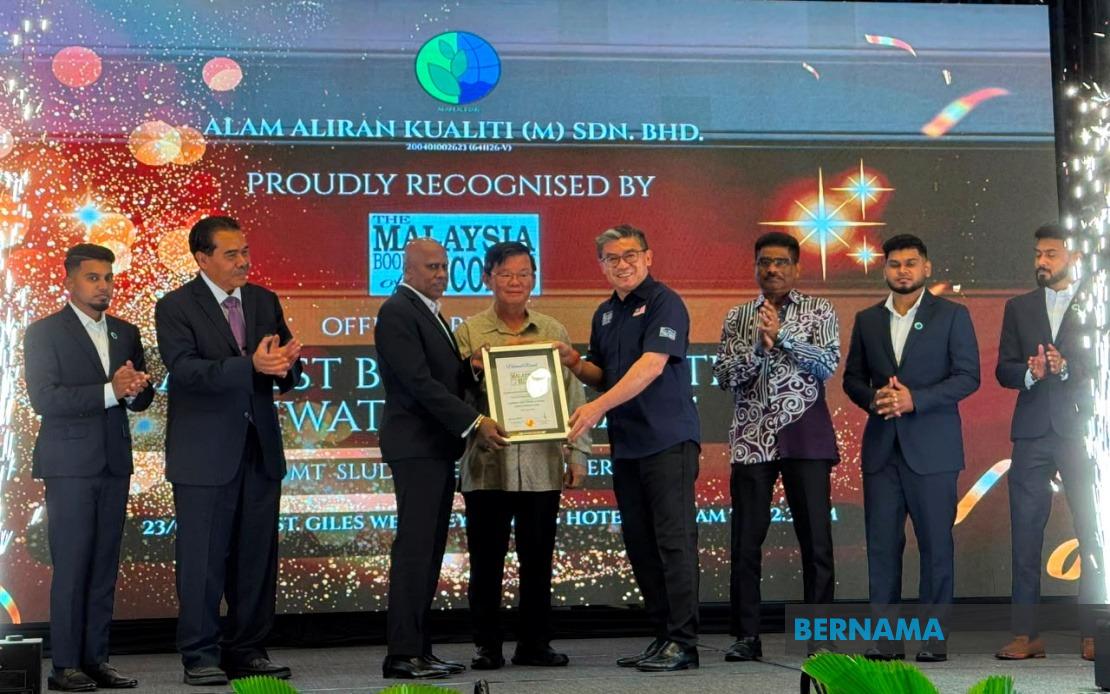
Alam Aliran Kualiti (M) Sdn Bhd (AAK) has secured a Malaysian Book of Records (MBOR) recognition for developing and operating the country's largest belt press system dewatering plant, located at Sungai Dua in Penang. The accolade underscores Malaysia's growing capacity in environmental engineering infrastructure and signals a shift towards more sustainable approaches to managing water treatment residuals, a historically problematic waste stream that has long challenged water authorities across the region.
The Sungai Dua facility, developed in partnership with Perbadanan Bekalan Air Pulau Pinang (PBAPP), represents a sophisticated engineering response to one of the water industry's most persistent challenges: the disposal of treatment sludge generated during drinking water purification. With a processing capacity of 10 million litres per day, the plant manages approximately 450 tonnes of alum sludge daily—a remarkable volume that positions it among the region's most significant installations of its kind. This scale of operation demonstrates the viability of advanced dewatering technologies at commercial levels within Southeast Asia's water infrastructure.
The recognition carries particular significance beyond the numerical achievement itself. According to AAK director Gokulaan Balan, the milestone validates Malaysian engineering capability to design and deploy infrastructure meeting international standards. In a regional context where water scarcity and infrastructure investment remain pressing concerns, the success of locally developed solutions provides a template for other water authorities grappling with similar technical challenges. The project's advancement reflects broader industry trends toward closing material loops and maximising resource efficiency in water operations.
What distinguishes the Sungai Dua installation from conventional dewatering approaches is its integration into a comprehensive circular economy model. Rather than simply concentrating sludge for landfill disposal—the traditional endpoint for water treatment residuals—AAK has developed a complementary manufacturing process that transforms the processed material into Eco Green Cement Bricks. This value-addition component fundamentally reshapes the economics of sludge management, converting a cost centre into a revenue-generating operation whilst simultaneously diverting substantial waste volumes from landfills. For Malaysian municipalities and water utilities facing mounting disposal costs and shrinking landfill capacity, this dual-purpose approach offers tangible operational and financial benefits.
Penang Chief Minister Chow Kon Yeow emphasised the project's broader implications during the recognition ceremony in George Town. He highlighted how the facility's operational practices address water security challenges specific to Penang, a state that has confronted significant supply pressures in recent years. By recovering treated water from the dewatering process and recycling it back into treatment operations, the plant reduces overall water losses within PBAPP's distribution network. This internal recycling function, though often overlooked in public discussion, contributes meaningfully to water conservation at a statewide level where every litre of recovered supply strengthens resilience against dry seasons and growing demand.
The environmental credentials of the initiative extend beyond water recycling alone. Chow noted that the transformation of treatment residuals into construction materials exemplifies how environmental responsibility and economic value creation can align. The Eco Green Bricks produced at the facility offer construction applications whilst utilising material that would otherwise require costly and space-intensive landfill storage. For a country pursuing circular economy objectives as part of its broader sustainability commitments, such practical demonstrations of waste valorisation carry weight in policy discussions and investment decisions.
AAK's operational track record provides context for understanding the significance of this achievement. Established in 2004, the company has built expertise spanning environmental engineering and scheduled waste management across two decades of operations. The Sungai Dua installation represents the culmination of this accumulated experience, combining technical sophistication with proven operational reliability. The facility's management of SW204 scheduled waste classification materials—industrial sludges requiring careful handling and processing—demonstrates competency with hazardous material streams, a capability not uniformly available across Malaysia's environmental services sector.
The collaborative structure underlying the project warrants attention as well. The partnership between AAK, PBAPP, and oversight from Pengurusan Aset Air Berhad (PAAB) reflects institutional frameworks designed to leverage private sector innovation whilst maintaining public sector control over essential water infrastructure. As Malaysian authorities increasingly explore public-private engagement models for infrastructure development and operations, the Sungai Dua example provides evidence that such arrangements can deliver world-class technical outcomes. The involvement of Penang's state government leadership in the recognition ceremony signals political commitment to supporting advanced environmental infrastructure within the state's development priorities.
Gokulaan Balan framed the MBOR recognition as a beginning rather than a conclusion, emphasising that the achievement creates obligations for continued innovation and enhanced environmental stewardship. This perspective aligns with industry evolution toward ever-higher performance standards in water management. As global best practices filter into regional markets and stakeholder expectations around environmental accountability increase, facilities like Sungai Dua establish benchmarks that influence future infrastructure specifications and investment criteria across Southeast Asia's water sector.
For Malaysian readers and regional observers, the significance of this recognition extends beyond corporate achievement to reflect broader national capability development in critical infrastructure domains. Water security remains a defining challenge for developing economies across tropical Asia, where population growth, urbanisation, and climate variability place mounting pressure on both supply and treatment systems. The successful deployment of advanced dewatering and waste valorisation technologies within Malaysia demonstrates that solutions to these challenges need not be imported wholesale from developed economies. Indigenous engineering expertise, supported by appropriate investment and institutional frameworks, can generate competitive innovations addressing regional circumstances and constraints.
The path forward for AAK and similar enterprises involves scaling these innovations and extending circular economy principles across Malaysia's fragmented water utility landscape. While the Sungai Dua facility represents current-state excellence, its ultimate value lies in serving as a model prompting other water authorities to reassess their residuals management practices and consider upgraded approaches. As regulatory frameworks increasingly emphasise environmental standards and waste reduction, installations demonstrating both technical viability and economic sustainability become catalysts for sector transformation.

