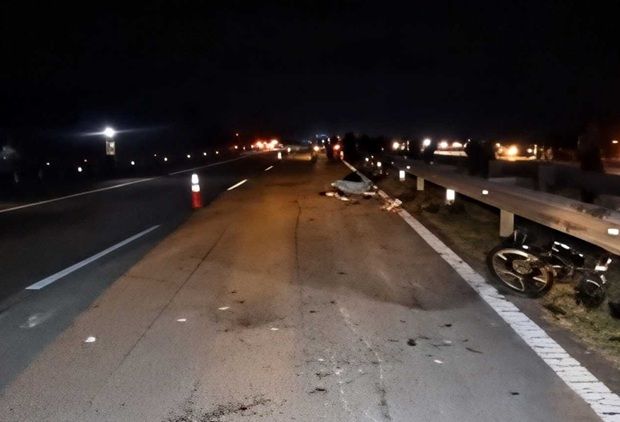
Four lives ended in darkness on the East Coast Expressway, their motorcycles scattered across the asphalt after a catastrophic collision near 1am last Saturday. By the time emergency responders could do nothing more, three men lay dead at the scene, with a fourth succumbing to injuries in hospital. Thirteen others bore the physical marks of survival, their bodies bruised and broken. Within hours, the incident had ignited a familiar cycle of blame and recrimination across social media, with armchair critics dissecting every detail and demanding accountability. Yet amid the noise of public judgment lay a quieter, more urgent truth that deserved far greater attention.
In the aftermath of those four deaths, eight children—some barely toddlers, others in their early teens—woke to a reality utterly transformed. Ages ranging from one to thirteen, these sons and daughters now faced a world without the men who had laboured to provide their daily bread, pay their school fees and keep a roof over their heads. The loss rippled far beyond grief. It created an immediate, pressing material crisis that would unfold across years and decades. The mothers left behind faced the impossible burden of single parenthood, tasked with generating the income once supplied by two adult wages while simultaneously managing the emotional and practical demands of raising children alone.
The financial calculus becomes staggering when laid bare. There was milk to purchase for infants still learning to walk, rent demanding payment each month, kindergarten fees that would not wait, clothes that grew too small as children aged, and crucially, meals substantial enough to nurture growing bodies and developing minds. As these children advanced toward adolescence and adulthood, the cost of education would only accelerate, tuition fees rising faster than inflation. University fees, if those aspirations were to be realised, would require resources these families struggled to imagine. The men who once shouldered these burdens had vanished, leaving behind a void that seemed impossible to fill.
It is in such moments—when catastrophe strips away the illusion of permanent security—that the true function of social security schemes emerges with clarity. Yet awareness among Malaysians of what such systems actually provide remains troublingly low. Social security exists not as a reward for virtue or compensation for misfortune alone. It functions instead as a mechanism of collective solidarity, built on a principle both ancient and essential: that the strong temporarily support the weak, that those spared tragedy stand alongside those who suffer its weight, that citizens still capable of standing extend a hand to those who have fallen. The system embodies a fundamental social contract, a guarantee that when disaster threatens to collapse the architecture of a family's life, particularly when children are at stake, that family will not be abandoned to poverty and despair.
In the case of the three victims whose families qualified for benefits, PERKESO's Survivors' Pension translated this principle into concrete financial protection. The family of Che Mohd Suffian Che Gani became eligible to receive RM2,207.63 monthly, calculated according to his contribution history. Muhammad Hafiz Al Hakim Mazlan's dependants qualified for RM1,258.33 each month, while Mohd Aizat Husni's family received RM708.33. These payments were not arbitrary gifts, but rather the return of contributions made over working years, now flowing back as protection when needed most. Under the apportionment formula applied, the three widows secured lifetime pensions of RM1,325, RM755 and RM425 respectively—amounts that, while modest, represented the difference between stability and destitution across three decades of raising their children to adulthood.
When extended across time, the mathematics reveal the true value embedded in these contributions. Projecting those widow pensions over thirty years yields totals of RM477,000, RM271,800 and RM153,000 respectively. Simultaneously, a collective RM1,670 monthly was allocated across the eight children, structured to provide RM300,600 over the fifteen years required to raise them into independence. Combined, PERKESO's long-term commitment to these affected families exceeded RM1.2 million—a figure that transforms these abstract pension calculations into something tangible: a genuine lifeline preventing catastrophic poverty.
These numbers matter precisely because they illustrate how modest deductions during prosperous working years accumulate into substantial protection when crisis arrives. A worker earning a steady wage, contributing steadily through payroll deductions that scarcely register during monthly budgeting, had made an invisible pact with society: in exchange for this regular contribution, should disaster strike, the system would stand as guarantor for his dependants' survival. The man crossing the East Coast Expressway on his motorcycle had made those contributions. He could not have known he would not survive that journey, but the system knew that someone wouldn't, and it had prepared accordingly. This is not temporary relief or charity redefined; it is the realisation of an ongoing responsibility that extends beyond death itself.
Equally significant was the impact on those who survived. Among the thirteen injured victims, five qualified for benefits under the newly expanded Lindung 24 Jam scheme—a programme that fundamentally altered what would otherwise have occurred. Prior to June 1, when this scheme took effect, PERKESO would have faced legal restrictions preventing approval of their claims. Injured workers who survived but faced prolonged rehabilitation, medical costs and lost income would have fallen outside the safety net entirely. They would have joined the tragic statistics of legitimate claims that the system was powerless to support. Instead, Lindung 24 Jam extended protection to precisely these cases—the survivors whose injuries were serious enough to demand ongoing support but whose circumstances did not fit previous legal categories.
The expansion of coverage under Lindung 24 Jam represents a recognition that social security must adapt to modern accident patterns and economic realities. In an era where motorcycle accidents along expressways occur with grim regularity, where many workers remain precariously positioned between employment and self-employment, where family structures vary far beyond traditional models, the social security system must evolve to meet contemporary needs. Those five injured survivors now had access to benefits that provided crucial support during recovery—benefits that could mean the difference between returning to work and sliding into permanent disability, between maintaining family stability and fracturing under economic strain.
This tragedy also illuminates a broader challenge facing Malaysian society: the persistent gap between what social security systems can provide and how widely the population understands their own eligibility and benefits. Many workers, like the families affected by this crash, discover the value of their contributions only after disaster forces the issue. Awareness campaigns, workplace education and genuine effort to demystify these schemes remain inadequate. The fear and shame associated with needing assistance, cultural preferences for family support over institutional help, and simple lack of knowledge all conspire to leave potential beneficiaries unaware of their rights.
For the widows and children now receiving PERKESO support, the difference is not merely financial, though that matters enormously. The emotional weight of knowing that society has not abandoned them to face tragedy's consequences alone carries its own significance. The certainty that education costs can be met, that basic necessities will not vanish, that futures can still be pursued—these dimensions of security extend far beyond the arithmetic of monthly payments. Conversely, for the broader Malaysian public, this tragedy offers an opportunity to reconsider how social security systems deserve respect and understanding, not dismissal or belittlement.
The debate over road safety, vehicle maintenance, speed regulation and individual responsibility remains valid and necessary. Dangerous riding that endangers others must face legal consequences. Yet these conversations need not eclipse a parallel, equally important recognition: that the protection woven into social security schemes represents a fundamental promise about how society treats those struck by misfortune. The children who lost their fathers on the East Coast Expressway did nothing to deserve their circumstances. The system ensuring they would not face destitution as a result of their loss embodies something worth defending, understanding and strengthening as Malaysia continues developing its social infrastructure.

