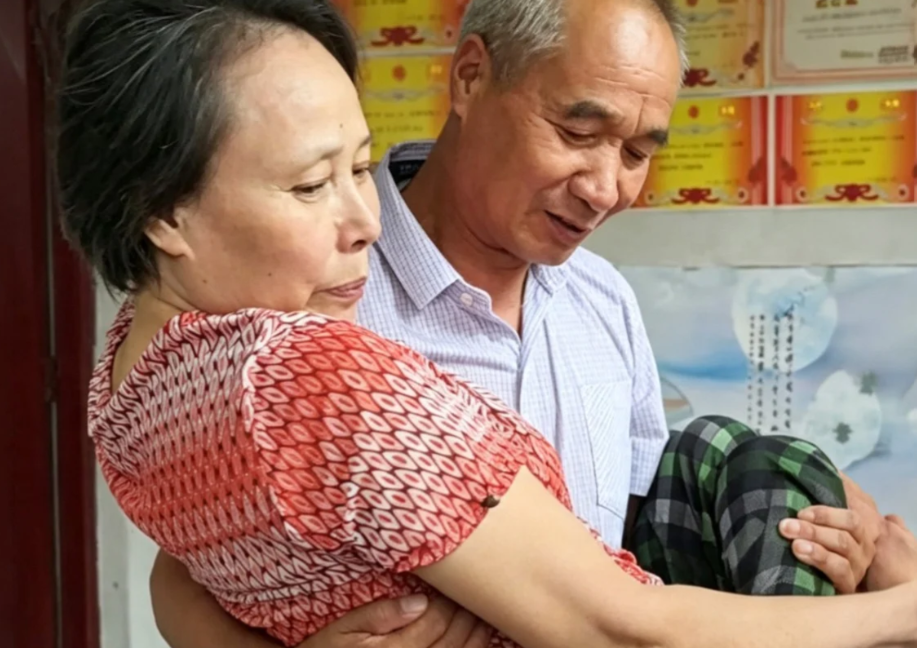
In the heartland of central China, one man's unwavering dedication to his disabled wife has resonated deeply with millions of people online, offering a powerful testament to marital commitment in an era when such devotion is increasingly rare. Li Junliang, a resident of Pingdingshan in Henan province, has spent the past 25 years as the sole caregiver for his wife Jia Fang, who became severely paraplegic after a devastating accident that altered the trajectory of their entire family.
The turning point came in 2001 when Jia, then 36 years old, suffered life-altering injuries while riding in a pedicab that plunged over a cliff. The fall left her paralysed from the chest downwards, robbing her of physical independence and confining her to bed. Their two children—aged 13 and 10 at the time—suddenly faced a household transformed by tragedy. Yet rather than succumb to despair, Li made a quiet decision that would define the next quarter-century: he would be her caregiver, day and night, for as long as needed.
The physical demands placed upon Li have been extraordinary and relentless. During the earliest years following Jia's accident, he turned her body every two hours without fail to prevent the painful and dangerous condition of bedsores that frequently afflicts immobilised patients. This gruelling schedule meant forgoing uninterrupted sleep—a sacrifice he maintained for years before gradually extending the interval to four hours as Jia's condition stabilised. Even with this adjustment, two decades have passed since Li has known what a full night's rest feels like. Beyond the turning, he performs regular limb massages to maintain whatever muscle tone remains and prevent the progressive deterioration that characterises prolonged paralysis.
Li's commitment extends beyond the purely medical dimensions of caregiving. He lifts his wife into a wheelchair whenever weather permits, transporting her outside to experience sunlight and fresh air—small mercies that most people take for granted but which require considerable physical strength and planning. The home he maintains is spotless and well-organised, details that neighbours have remarked upon with admiration. Simultaneously, he shouldered the responsibility of raising their growing children, ensuring they received educational support while managing the emotional complexities of a household forever changed by disability.
The couple's children have since matured into independent adults with families of their own, and the certificates adorning their home walls speak to the educational achievements Li helped facilitate despite the extraordinary pressures he faced. Yet through all these decades, his primary focus remained the woman whose presence he deemed essential to any sense of home or completeness. The specifics of how Li generates income to support the family remain unclear, but somehow he has managed to provide financially while delivering full-time care—a logistical feat that underscores the depth of his commitment.
When Jia reflected publicly on her husband's sacrifice, she acknowledged the physical toll visible in his appearance. His hair has turned completely grey while hers remains predominantly black, a stark visual metaphor for the asymmetrical burden they have carried. Her gratitude was unambiguous: "Junliang, thank you for taking care of me for 25 years," she said. Yet Li's response revealed the philosophical framework underpinning his choices. He framed his caregiving not as burden or obligation, but as a continuation of promises made on their wedding day—vows that "home is complete only with your presence" took on profound new meaning after Jia's paralysis.
Li's declaration that he would willingly care for Jia for another 25, 35, or even 45 years was not rhetorical flourish but rather a steady statement of fact. He articulated that Jia had fulfilled her role as wife and mother to their children, and that continuing to provide care was not sacrifice but reciprocal commitment. This reframing of disability care as mutual marital responsibility rather than one-directional hardship offers a counternarrative to prevailing attitudes toward caregiving for severely disabled spouses in contemporary Asia.
Jia herself expressed remarkable emotional resilience, stating that she considers herself "the happiest person in the world" to have married such a devoted man. This claim might seem paradoxical to outsiders—a woman paralysed from the chest down declaring happiness—yet it speaks to the psychological sustenance provided by being cared for with genuine tenderness rather than clinical detachment or resentment. Their relationship appears to have deepened rather than fractured under the weight of disability.
Neighbours who have witnessed this partnership firsthand have been struck by its ordinariness combined with its extraordinariness. One unnamed neighbour expressed genuine amazement that Li's home remained clean and tidy while he single-handedly managed caregiving, housework, and family responsibilities. The observation reflects broader societal recognition that such devotion is statistically uncommon. Many spouses in similar circumstances have chosen to place disabled partners in institutional care or have abandoned their obligations altogether, making Li's consistency remarkable by contemporary standards.
The couple's story has penetrated the consciousness of millions across mainland China through social media, generating waves of commentary that reveals both admiration and perhaps some discomfort with the implicit critique of modern values their example represents. Online observers have described themselves as "moved" and "touched" by Li's example, with some invoking spiritual language about divine blessings and cosmic reward for such faithfulness. These responses suggest that Li and Jia's lived experience has tapped into deeper cultural anxieties about the erosion of traditional family values and enduring commitment in rapidly modernising Chinese society.
From a broader perspective, their story illuminates the gendered dimensions of caregiving in Asia, where women disproportionately shoulder unpaid care labour yet remain systemically undervalued. The reversal here—a man providing full-time care for his wife—subverts typical patterns while simultaneously reinforcing traditional marriage narratives about permanence and unconditional commitment. For Malaysian readers and Southeast Asian audiences more broadly, the case of Li and Jia raises important questions about how societies structure support for disabled individuals and whether institutional care systems adequately complement family-based approaches to disability management.
The practical implications for policy remain largely unexamined in the media coverage. Questions linger about whether Li receives any government support, community resources, or healthcare assistance in managing Jia's medical needs. The absence of such information suggests that this caregiving burden falls entirely upon one individual and his family resources—a situation that may work adequately in this particular case but hardly represents a sustainable social model for disability care as populations age and disability prevalence increases across Asia.

