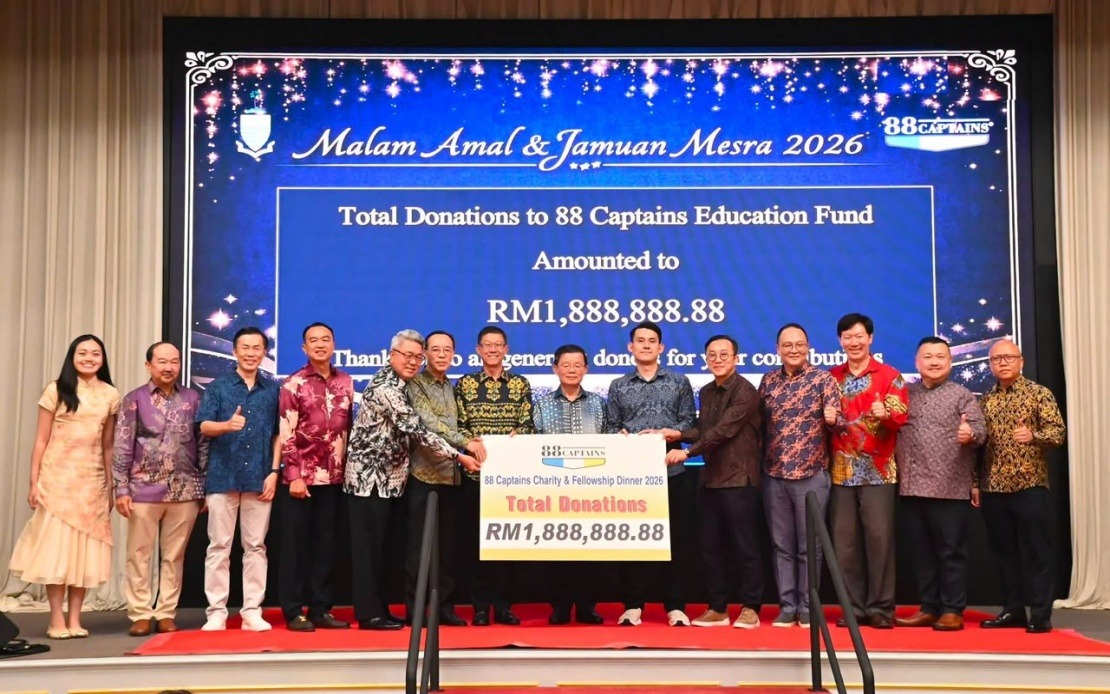
The 88 Captains organisation, a Penang-based charity dedicated to nurturing young talent across Malaysia's northern region, has distributed scholarships exceeding RM1 million to 44 deserving students drawn from five educational institutions. The disbursement represents a significant investment in human capital at a time when Malaysian employers increasingly grapple with skills gaps and graduate readiness, making such initiatives particularly relevant for the region's economic competitiveness.
Datuk Seri Dr Ooi Eng Hock, who chairs the organisation formally known as Persatuan Kebajikan 88 Kapten Pulau Pinang, emphasised that the scholarship programme extends beyond mere financial relief. Rather, he framed the initiative as a mechanism to cultivate ambition and resilience among young people, encouraging them to set ambitious goals, pursue excellence, and ultimately contribute meaningfully to Malaysian society through both professional achievement and ethical conduct. This framing aligns with growing recognition that financial support alone cannot address the deeper challenge of producing graduates with the character and mindset demanded by modern employers.
Central to 88 Captains' strategy is the Apprenticeship, Internship, Reskilling and Upskilling programme, or AIRU, which was inaugurated last year at Universiti Sains Malaysia in George Town. This initiative represents an attempt to create structured pathways that connect classroom learning with real-world workplace expectations, addressing a persistent disconnect that has long frustrated both educators and industry leaders across Southeast Asia. By formalising these connections, the programme aims to reduce the transition friction that typically affects fresh graduates entering the labour market.
The organisation has assembled a task force comprising high-achieving scholars from USM, ViTrox College, Tunku Abdul Rahman University of Management and Technology, and INTI International University. These representatives serve as bridges between the academic and corporate worlds, meeting with business leaders and company founders to understand what skills and attributes the market actually requires. Critically, this dialogue has surfaced a concrete benchmark: participating employers expect graduates to command minimum starting salaries of RM4,000, a figure that reflects both market expectations and the cost of living realities facing young professionals in Malaysia today.
The latest phase of 88 Captains' fundraising culminated in the Annual Charity Dinner 2026 held in George Town, which successfully raised RM1.89 million. The event's prominence—attended by Penang Governor Tun Ramli Ngah Talib, his wife Toh Puan Raja Noora Ashikin Raja Abdullah, and Chief Minister Chow Kon Yeow—underscores how education and talent development have become bipartisan priorities within Malaysian state governance. This political alignment suggests potential for sustained policy support and resource allocation to such initiatives.
Over the preceding four years, 88 Captains has demonstrated scope and ambition beyond scholarship distribution. The organisation has orchestrated more than 50 discrete events and executed numerous community programmes, including the donation of smart televisions to primary and secondary schools, establishment of 5G Education Digital Libraries across 88 schools, and meaningful support for the Special Education Integration Programme. These initiatives collectively signal recognition that talent development demands investment across multiple dimensions—from infrastructure and technology access to inclusive education frameworks.
Chief Minister Chow Kon Yeow publicly endorsed 88 Captains' work as strategically aligned with Penang's broader economic aspirations. He specifically noted how the AIRU programme reinforces linkages between tertiary education and industrial application, directly supporting the state's ambition to establish itself as a regional hub in advanced manufacturing, semiconductors, artificial intelligence, and the digital economy. This alignment illustrates how private charitable action can be leveraged to advance state-level economic policy objectives, creating synergies that benefit both youth and regional competitiveness.
A recent initiative under 88 Captains' portfolio—the Joint Mental Health Development in Schools with AI Early Education for Responsible Adoption—addresses an increasingly urgent dimension of student welfare. Launched earlier in the week, this programme arrives at a particularly timely moment, coinciding with Malaysia's enactment of the Anti-Bullying Act 2026. While legislation provides the statutory framework, Chow emphasised that prevention and intervention require engagement from multiple stakeholders: schools must equip teachers with appropriate tools and training, families must foster supportive environments, and communities must actively promote digital citizenship and responsible technology use among young people.
The 88 Captains organisation itself remains relatively young, having been established in 2022 with an explicit mandate to support talent development through financial assistance to deserving students across Penang and Malaysia's northern region. This four-year trajectory demonstrates how focused, well-managed charitable organisations can accumulate resources and expand impact relatively rapidly when backed by committed donors and clear strategic direction. The organisation's growth from inception to distributing over RM1 million annually suggests a sustainable funding model rooted in genuine community support.
For Malaysian policymakers and educators, 88 Captains exemplifies a model that transcends conventional scholarship provision. By explicitly connecting financial aid with industry engagement, mental health support, digital infrastructure, and inclusive education, the organisation addresses multiple constraints that typically impede talented but disadvantaged students from reaching their potential. The framework acknowledges that talent exists across all socioeconomic strata, but realising that talent requires coordinated investment across financial, infrastructural, psychological, and relational domains.
The emphasis on bridging academia and industry carries particular resonance for Malaysia's ongoing efforts to build a knowledge economy while simultaneously addressing persistent skills mismatches. Southeast Asian economies increasingly compete on innovation and high-value manufacturing rather than labour-cost advantages, making the quality of graduate preparation decisive for regional competitiveness. Initiatives like 88 Captains' AIRU programme, by systematically connecting employer expectations with university curricula and student development, help accelerate this transition.
Looking forward, the scholarship distribution and programmatic initiatives supported by 88 Captains demonstrate that substantial progress on talent development need not await government intervention alone. When private individuals and organisations mobilise resources around clear educational objectives, they create additional capacity and innovation space that complements public sector efforts. The organisation's success in attracting over RM1.89 million at a single charity dinner, and its accumulation of support across four years, suggests appetite among Malaysian philanthropists to invest in education when presented with credible, results-oriented organisations.

