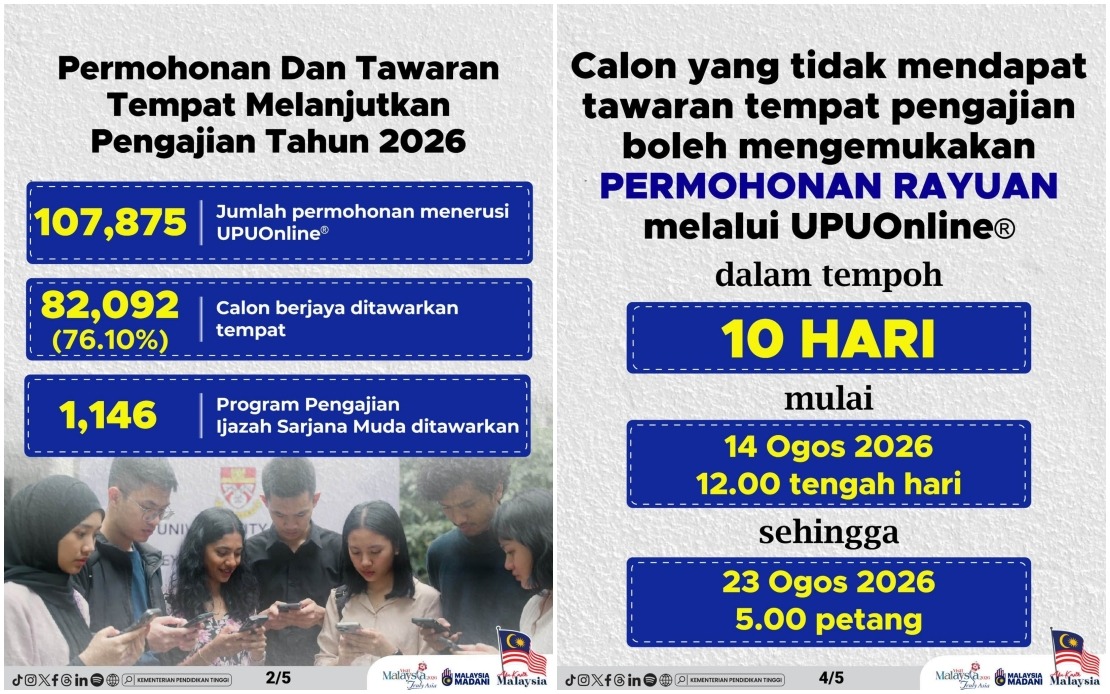
The Ministry of Higher Education (KPT) announced on 14 August that 82,092 candidates have secured undergraduate admission offers at Malaysia's 20 public universities for the coming academic year. This intake represents a significant milestone in the nation's higher education landscape, with the selection process drawing from a substantial pool of 107,875 qualified applicants who submitted their applications through the UPUOnline portal. The successful candidates will gain access to 1,146 distinct bachelor's degree programmes offered across the participating institutions, providing diverse pathways for academic specialisation and professional development.
The acceptance rate of 76.10 per cent reflects the competitive nature of Malaysia's public university system, where demand for tertiary education continues to outpace available spaces. This competitive environment underscores the importance of merit-based assessment in determining student placement, ensuring that limited institutional resources are allocated to candidates demonstrating the strongest academic credentials. The selection mechanism, which arranges all eligible candidates according to merit scores in descending order, maintains consistency with the government's commitment to meritocratic principles in educational access. For Malaysian students and their families, this figure represents both opportunity and challenge—while nearly three-quarters of qualified applicants will commence their university studies, a substantial portion will face the prospect of navigating alternative pathways or appealing their outcomes.
From a systemic perspective, the intake numbers illuminate ongoing pressures within Malaysia's higher education sector. With over 25,000 qualified candidates not receiving offers despite meeting eligibility standards, questions emerge regarding capacity constraints and the adequacy of current infrastructure. This gap between demand and supply has broader implications for workforce development, social mobility, and regional competitiveness. Many Southeast Asian nations face similar challenges as demographic expansion and rising educational aspirations collide with limited public investment in tertiary institutions. Malaysia's situation mirrors regional trends, where public universities serve as the primary gateway to higher learning for middle and lower-income students, making equitable access a matter of national concern.
The ministry's emphasis on meritocracy as the guiding principle for admissions reflects a deliberate policy orientation aimed at ensuring transparency and fairness in the selection process. By prioritising academic performance as measured through merit scores, the system theoretically eliminates subjective considerations and ensures that positions flow to the most academically prepared candidates. However, this approach also raises important considerations about educational equity, as students from different socioeconomic backgrounds may have differential access to quality secondary education and examination preparation resources. The merit-based framework, while administratively straightforward, does not necessarily account for such structural inequalities that may influence academic performance prior to university application.
For successful applicants, the admission offers represent the culmination of years of academic effort and the beginning of a new chapter in their educational trajectories. The ministry's message to these candidates emphasises the importance of maximising this opportunity, reflecting an institutional hope that admitted students will fully engage with their chosen programmes and contribute meaningfully to Malaysia's knowledge economy. University education in Malaysia continues to serve as a critical mechanism for credential acquisition, professional credentialing, and social advancement, particularly for first-generation university students from non-elite backgrounds. The diversity of 1,146 programmes means that successful candidates will pursue studies across fields ranging from engineering and medicine to humanities and social sciences, collectively preparing the next generation of Malaysia's professional workforce.
For the majority of candidates who did not receive immediate offers, the ministry has established a structured appeal mechanism designed to provide a second opportunity for consideration. This 10-day window, commencing on 14 August at noon and concluding on 23 August 2026 at 5pm, allows unsuccessful applicants to lodge appeals through the UPUOnline system. The existence of this appeal channel acknowledges that the initial selection process, while rigorous, may not capture all deserving candidates, and that additional consideration of borderline cases can yield equitable outcomes. For many students, this appeal period represents a crucial window during which circumstances, achievements, or documentation previously overlooked might be presented to adjudication panels. The structured nature of the appeal process, with clear deadlines and procedures, ensures administrative clarity whilst also potentially reducing anxiety among unsuccessful candidates by providing explicit recourse.
The timing of these announcements in mid-August positions the public university admission cycle during the latter stages of Malaysia's academic calendar, when secondary school students are concluding their final examinations and beginning to contemplate their tertiary options. This scheduling allows students who receive offers to prepare for university entry within a compressed timeframe, whilst also creating urgency around appeal submissions and alternative pathway decisions. The compressed timeline reflects the operational realities of Malaysia's education system, where institutional calendars must synchronise across thousands of schools, assessment bodies, and universities operating within defined academic years. For students and parents navigating this system, the relatively rapid progression from examinations to university admission decisions requires careful attention to official communications and adherence to specified procedural deadlines.
Regionally, Malaysia's undergraduate admissions process occurs within a broader Southeast Asian context of rising educational ambitions and evolving higher education policy frameworks. Neighbouring countries including Indonesia, Thailand, and Vietnam similarly manage large volumes of university applicants annually, with each nation adopting distinctive approaches to balancing meritocratic principles, institutional capacity, and equity concerns. Malaysia's transparent, centralised UPUOnline portal represents a relatively advanced digital infrastructure for admissions management compared to some regional peers, though continued digitalisation efforts remain ongoing. The 82,092 admission offers thus reflect not merely a domestic educational milestone but also positioning within regional competitive dynamics around university education quality, accessibility, and outcomes.
The ministry's statement extending best wishes to successful candidates carries both celebratory and aspirational dimensions. Beyond the conventional congratulatory language, it implicitly frames university admission as the beginning of a developmental journey rather than a conclusive achievement. This framing aligns with contemporary discourse emphasising lifelong learning, skills development, and continuous professional adaptation in rapidly evolving labour markets. The successful candidates will be expected not merely to complete degree requirements but to cultivate competencies—both technical and soft skills—that extend beyond traditional academic assessment. The institutional expectation embedded in the ministry's message is that admitted students will leverage their university experience to contribute constructively to Malaysian society through subsequent professional endeavours, research contributions, or civic engagement.
Looking forward, the annual repetition of this admissions cycle will continue shaping the educational pathways of hundreds of thousands of Malaysian youths. The persistence of a substantial gap between qualified applicants and available spaces suggests that ongoing policy discussions should encompass questions about optimal public university expansion, potential satellite campuses, online degree delivery, or enhanced partnerships with private institutions to accommodate demand more comprehensively. Strategic decisions made regarding these admissions numbers today will reverberate through Malaysian society for decades, influencing career trajectories, income distributions, and social structures across generations. The 82,092 successful candidates represent not only individual success stories but also a collective investment in Malaysia's human capital and intellectual infrastructure, with implications for national development and regional influence.

