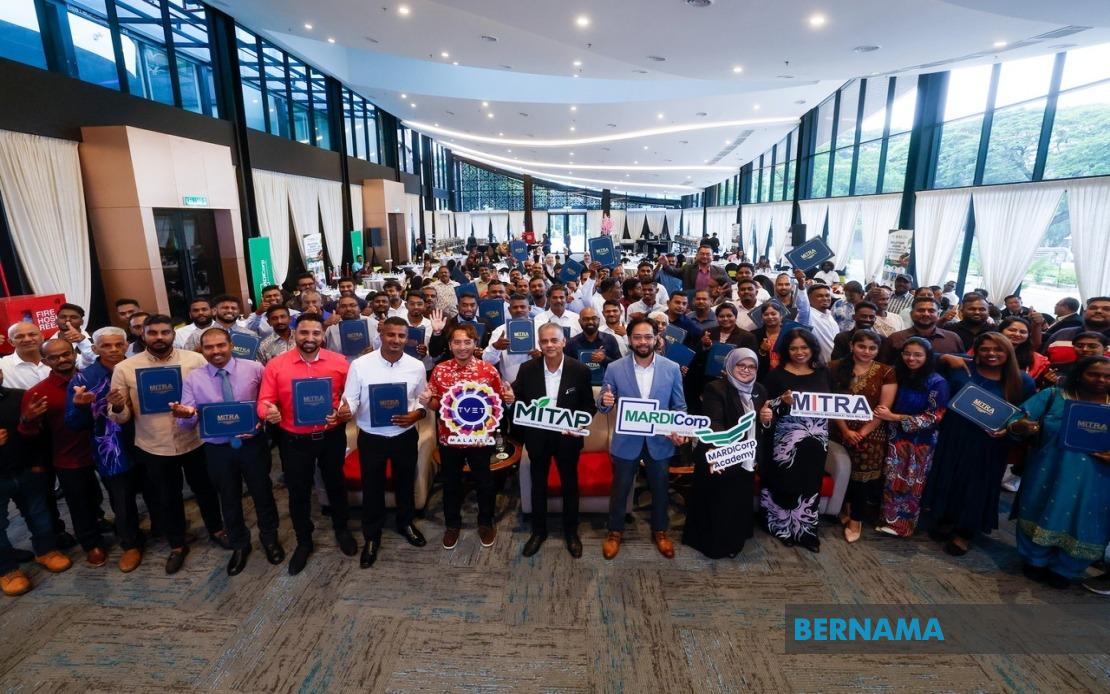
Putrajaya has become the stage for a significant push to diversify agricultural participation among Malaysia's Indian community, with 68 young agropeneurs receiving RM30,000 in grants each through the Malaysian Indian Transformative Agri Programme. The initiative represents a deliberate effort to channel financial support and technical expertise toward emerging farmers seeking to establish themselves in various agricultural sectors, from conventional crop farming to specialised ventures like beekeeping and mushroom cultivation.
The programme operates under the Malaysian Indian Community Transformation Unit, operating in partnership with MARDICorp as part of the broader Indian Community Socioeconomic Development Programme. This structural arrangement underscores how targeted government initiatives increasingly funnel support through dedicated units focused on specific communities, reflecting Malaysia's approach to addressing socioeconomic disparities and expanding economic opportunities across different demographic segments. By positioning agriculture as a vehicle for community advancement, the initiative acknowledges both the sector's importance to rural livelihoods and its potential to generate sustainable income streams.
K. Raveendran Nair, director-general of MITRA, outlined the programme's architecture during the grant presentation ceremony, describing how it functions as a dual-track operation combining immediate financial support with longer-term capacity building. The QuickWin MITRA component delivers the RM30,000 grants to qualified young farmers, while the Young Agropreneur Programme operates separately as a 10-month intensive training course designed to equip participants with technical and business acumen essential for agricultural entrepreneurship. So far, eight participants have completed the training track, demonstrating that the initiative is moving beyond announcement stage into implementation.
The diversity of sectors targeted under the Agricultural Transformation Grants reflects a deliberate strategy to prevent programme participants from competing directly with one another while maximising the range of agricultural opportunities available to the community. Food crop production remains the foundation, but the inclusion of dairy cattle management, beekeeping, oyster mushroom cultivation, freshwater fish farming, and food processing technology indicates a conscious broadening of what constitutes agricultural enterprise. This sectoral diversity allows participants to select ventures aligned with their local conditions, existing skills, and market accessibility, increasing the likelihood of sustainable outcomes rather than a one-size-fits-all approach that might generate early dropouts.
The sustainability angle becomes particularly relevant when examining how MARDICorp plans to support grantees beyond the initial cash injection. Mohamad Zamir Ghazali, the corporation's managing director, articulated a vision extending far beyond simple fund distribution, positioning MARDICorp as an ongoing partner in market development and technology adoption. His commitment to guiding participants through product marketing, downstream processing innovations, and technological upgrades suggests recognition that access to capital alone rarely determines agricultural success; the quality of technical mentorship and market linkages often proves decisive in separating viable enterprises from those that stall after initial funding exhaustion.
The networking dimension emphasized by Ghazali reveals a sophisticated understanding of how marginalised communities often struggle not just with capital or knowledge deficits but with exclusion from formal agricultural value chains. By bundling young farmers into associations and keeping them visible within government development frameworks, MITRA creates structural pathways for scaling operations and securing government contracts or programme access that might otherwise bypass small, unaffiliated producers. This collective approach contrasts sharply with the individualistic grant model, acknowledging that isolation itself constitutes a significant barrier to advancement.
For Malaysian policymakers and regional observers, the initiative offers lessons about targeted intervention design. By directing support toward a specific community demographic within agriculture, the programme embodies a recognition that broad sectoral policies may inadequately address the particular barriers faced by underrepresented groups. The Indian community's historically lower participation rates in commercial agriculture, whether attributable to land access challenges, credential recognition issues, or market exclusion, become susceptible to correction through programmes designed with community-specific knowledge and implementation partnerships.
The timing of this initiative also reflects broader policy trends in Southeast Asia, where governments increasingly acknowledge agriculture's role in inclusive economic development rather than viewing it as a declining sector suitable only for low-income rural populations. Malaysia's explicit investment in young agropeneurs—emphasising the youth demographic—sends a signal that farming can offer viable career pathways and wealth accumulation opportunities comparable to other sectors. This messaging matters significantly for community perceptions and career choices, particularly among younger generations often inclined toward urban service sector employment.
The RM30,000 grant level represents a carefully calibrated intervention amount. Substantial enough to establish genuine operational capacity—whether purchasing initial livestock, securing land preparation equipment, or investing in processing machinery—yet modest enough to require supplementary funding or income sources, thereby maintaining recipient accountability and diversification. This middle ground avoids both the appearance of tokenism associated with modest disbursements and the dependency risks potentially created by excessively generous allocations requiring minimal recipient contribution.
Looking forward, the programme's success metrics will likely extend beyond simple measurement of grant distribution numbers. Monitoring will probably track business survival rates, income generation relative to baseline conditions, employment creation within participant enterprises, and whether programme alumni develop into mentors for subsequent cohorts. The capacity building aspect embedded through the Young Agropreneur Programme suggests that MITRA developers understand that agricultural entrepreneurship requires ongoing skill upgrading; the initial 10-month curriculum can establish foundations, but real expertise emerges through years of operational experience combined with continuous engagement with emerging technologies and market shifts.
For the broader Malaysian economy and Southeast Asian agricultural development, these 68 individual grants and their supporting ecosystem represent modest investments with potentially outsized impact. If even a fraction of participants succeed in establishing profitable, scalable agricultural businesses, the multiplier effects through employment, raw material supply chains, and downstream processing could extend well beyond the immediate direct beneficiaries. Moreover, the success of community-specific agricultural initiatives in Malaysia may inform how neighbouring nations approach their own agricultural inclusivity challenges, particularly regarding how to meaningfully engage population segments historically peripheral to commercial farming.

