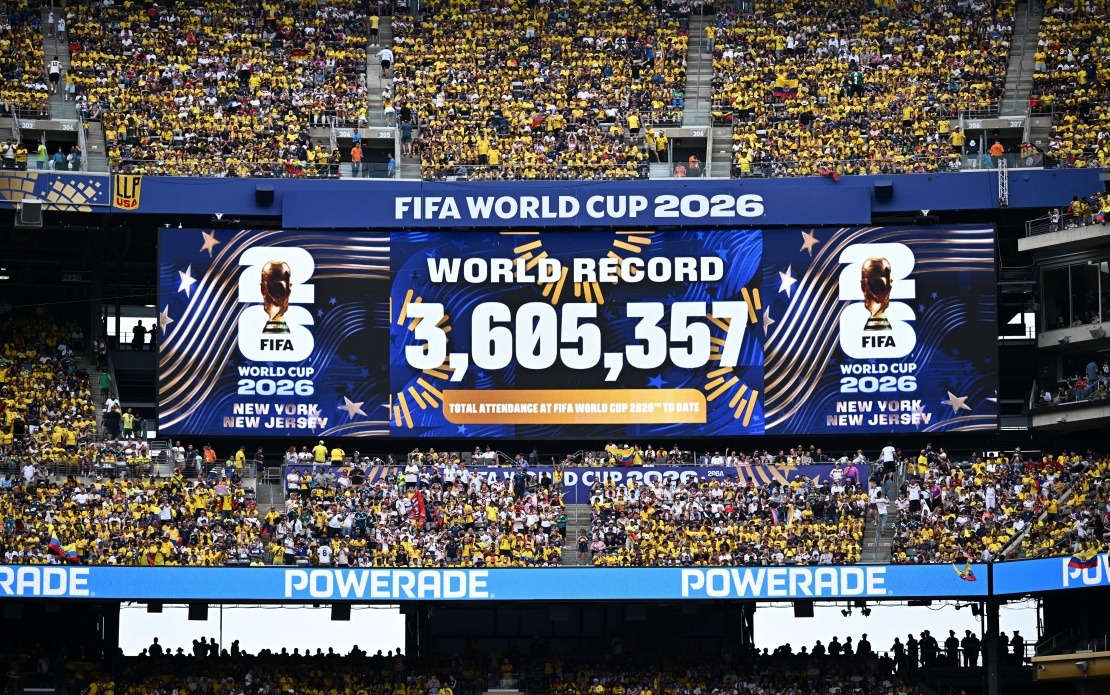
The 2026 FIFA World Cup has etched itself into sporting history as the most-watched tournament in the competition's storied 96-year existence. The milestone was announced during the Germany versus Ecuador match at East Rutherford in New Jersey on Thursday, when stadium displays revealed that cumulative attendance had crossed 3,605,357—comfortably surpassing the previous high-water mark of nearly 3.6 million set in 1994. The revelation prompted a groundswell of applause from the packed crowd, underscoring the scale of public engagement with football across the continent.
What makes this achievement particularly striking is its trajectory and what it portends for the tournament's final phase. The 2026 competition still has 48 matches remaining as it enters its closing stages, meaning total attendance figures could conceivably approach 7 million by the time the final whistle blows in the championship decider. This dramatic potential represents an almost complete doubling of the 1994 record—a vastly different proposition from the feat that held for over three decades, especially when one considers that the 1994 edition was spread across just 52 matches in a single country, whereas the modern format distributes matches across a much larger footprint.
The structural differences between these two record-breaking tournaments illuminate how football's global appeal has intensified and how infrastructure developments have transformed spectator accessibility. The 1994 World Cup, held across the United States, operated within a fundamentally different framework from the expanded 48-team, 16-nation hosting arrangement of 2026. The earlier tournament's concentration in one country allowed for more condensed scheduling, yet despite this advantage, it attracted fewer total viewers across its entire duration than the current tournament is generating halfway through its schedule. This inversion reveals something profound about the sport's current trajectory across North America and beyond.
The capacity utilisation figures underscore this phenomenon with remarkable consistency. Across the 16 host cities, stadiums have operated at more than 99 percent average capacity throughout the tournament's progression. Such near-universal full occupancy is virtually unprecedented in World Cup history and speaks to meticulous planning, strategic venue selection, and a genuine hunger among fans to witness international football's premier event in person. This consistent sell-out pattern contrasts sharply with earlier tournaments, where attendance could fluctuate significantly depending on local interest, fixture timing, and the drawing power of particular matchups.
The geographic distribution of the tournament has clearly amplified its reach. Rather than concentrating matches in a handful of major metropolitan centres, the 2026 format spreads fixtures across 16 host cities spanning three nations: the United States, Canada, and Mexico. This dispersal strategy has democratised access to World Cup football, allowing smaller markets and mid-sized cities to host matches that would previously have been the preserve of the continent's largest agglomerations. Communities that might never have anticipated hosting international football at this level have embraced the opportunity enthusiastically, contributing to the extraordinary attendance figures.
From a Malaysian and Southeast Asian perspective, these developments carry implications for how international sporting events are conceived and executed regionally. The success of the tripartite hosting arrangement demonstrates that World Cup football can thrive beyond the traditional European and South American strongholds, a model that could influence future bidding processes for major tournaments in Asia-Pacific nations. Malaysia, Vietnam, Thailand, and Indonesia have all harboured World Cup hosting ambitions at various points, and the 2026 blueprint—with its emphasis on distributed hosting and infrastructure development across multiple cities—offers a potentially more feasible pathway than the traditional single-nation model.
FIFA President Gianni Infantino characterised the attendance breakthrough as validation of football's undiminished capacity to unite diverse populations in shared celebration. His remarks emphasised that the scenes witnessed across the tournament's sprawling geographic footprint have been genuinely exceptional, suggesting that the sport's emotional resonance transcends traditional demographic and geographic boundaries. The ability of football to fill stadiums to near-maximum capacity across 16 different host cities, each with distinct demographics, climate conditions, and local sporting cultures, reinforces the sport's position as a singular global phenomenon with few genuine rivals.
The atmosphere within stadiums has reportedly remained electric throughout, with supporters across all 16 cities demonstrating consistent passion and engagement regardless of their local team's participation or fortune. This uniformly positive reception stands in contrast to some earlier World Cups, where particular venues or cities struggled to generate anticipated enthusiasm or where attendance dipped during less prominent fixtures. The 2026 tournament appears to have transcended such patterns, suggesting that the distributed format and the novelty of hosting across three nations has sustained interest across the entire competition schedule.
Looking ahead to the tournament's conclusion, the capacity for attendance to double the previous record hinges on maintaining the current momentum through the knockout phases, when traditionally the most intense competition and highest-profile matchups occur. Should the tournament's final weeks match the attendance intensity of its group stages, the cumulative figures will provide compelling evidence that World Cup football has genuinely expanded its appeal and accessibility. For FIFA and future host nations, the data being generated by the 2026 tournament will prove invaluable in shaping how the competition is conceived and executed in subsequent cycles.
The achievement also reflects broader transformations in how sporting infrastructure has evolved across North America. Purpose-built stadiums, renovated venues, and expanded capacity facilities across the United States, Canada, and Mexico have created conditions permitting such concentrated spectator flow. The investment these nations made in football-specific infrastructure over the past decade has demonstrably paid dividends, creating a foundation upon which the 2026 World Cup has built its record-breaking attendance legacy.
As the tournament progresses toward its climax, these attendance figures will likely continue to climb, potentially establishing benchmarks that subsequent World Cups will be measured against for decades to come. The record serves as a tangible indicator of football's enduring global appeal and its capacity to generate genuine mass participation in the spectatorial experience, even as entertainment options have proliferated and competition for leisure time has intensified.

