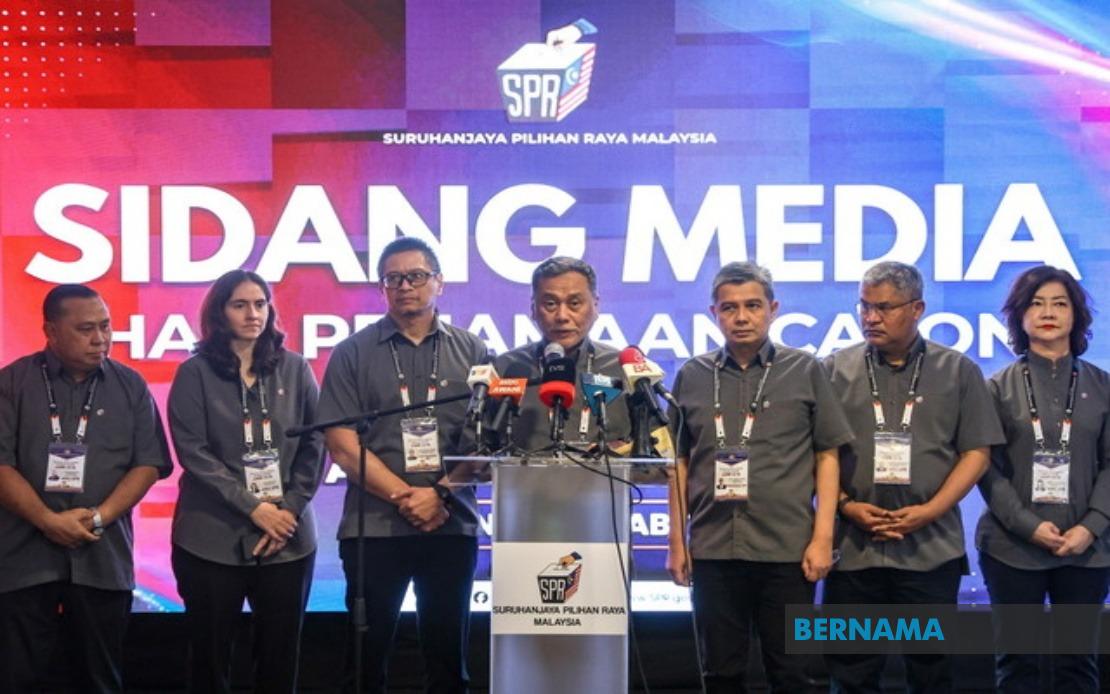
The Election Commission has cleared 172 candidates to compete in the 16th Johor state election after the nomination period ended at all 56 centres across the state. EC chairman Datuk Seri Ramlan Harun announced that all nomination papers were approved without disqualifications, setting the stage for what promises to be one of Southeast Asia's most closely watched regional contests in the coming weeks.
The candidate pool reflects the gender composition that increasingly characterises Malaysian electoral contests. Among the 172 nominees, 138 are male while 34 are female, a ratio that underscores ongoing efforts by various parties to improve gender representation in legislative bodies. This gender split, though still skewed toward male representation, indicates gradual shifts in how political organisations approach candidate selection, particularly among coalitions like Pakatan Harapan which has made gender diversity a stated policy objective.
The field is dominated by the two major coalitions. Barisan Nasional and Pakatan Harapan each nominated 56 candidates across all 56 seats, demonstrating their intention to contest every available position. This comprehensive coverage reflects both organisations' commitment to the state, where Johor's electoral outcome carries implications for national political dynamics given its size and economic significance within Malaysia's federation.
Perikatan Nasional has positioned itself as the third-largest contestant with 33 nominees, signalling its ambitions to consolidate the opposition vote and establish itself as a credible alternative to the two established coalitions. The grouping's fielding strategy suggests it is targeting specific constituencies while maintaining a presence throughout the state. Parti Bersama Malaysia, a newer entrant into Malaysian politics, has fielded 15 candidates, indicating its desire to gain parliamentary experience and build grassroots networks despite limited resources compared to established parties.
Smaller parties and independent candidates round out the competition. MUDA, which achieved significant youth support in recent national elections, has put forward four candidates. Both Parti Orang Asli Malaysia and Parti Sosialis Malaysia have fielded single nominees each, reflecting the challenges faced by niche parties in assembling full slates despite their ideological commitments. Additionally, six independent candidates are running, demonstrating that despite Malaysia's strong party system, individual contenders continue to test their viability in electoral contests.
The contest structure reveals a highly fragmented political landscape in which straight fights between two candidates will be rare. Only 14 of the 56 seats will feature head-to-head contests, suggesting that voters in the vast majority of constituencies will have multiple options. Three-cornered races involving three candidates will occur in 27 seats, making up nearly half the state. A further 12 constituencies will see four-way contests, while three seats will feature five candidates competing simultaneously. This fragmentation potentially complicates the electoral arithmetic and could allow candidates with plurality rather than majority support to prevail, depending on how votes split across the state.
For Malaysian observers, Johor's election holds particular significance given the state's historical role as an electoral bellwether. The state government has traditionally foreshadowed shifts in national political sentiment. A strong result for either Barisan Nasional or Pakatan Harapan could provide momentum heading into potential federal-level contests, while any breakthrough by Perikatan Nasional would signal changing voter preferences regarding established political structures. The state accounts for a substantial portion of Malaysia's economic output and population, making its governance outcome consequential for business confidence and federal-state relations.
The nomination process proceeding without disqualifications suggests that the Election Commission has maintained the procedural standards expected in Malaysian elections. Ramlan's confirmation that all documentation was in order indicates that candidate vetting mechanisms functioned as intended, although observers will note that such procedural smoothness does not necessarily guarantee electoral conduct free from dispute or irregularity during the actual polling period.
The candidate distribution across parties also illustrates the continued dominance of Malaysia's duopoly system despite rising competition. Barisan Nasional's and Pakatan Harapan's identical fielding of 56 candidates demonstrates that both organisations possess sufficient organisational capacity to contest comprehensively, a luxury that smaller competitors cannot match. This structural advantage may prove decisive in determining the election's outcome, as the major coalitions can allocate resources strategically and benefit from established party machinery and financing networks that smaller contenders typically lack.
Johor's election will unfold in the context of Malaysia's evolving political alignment. The state currently holds the chief minister position within one of the nation's political configurations, and the outcome could alter that balance. The clarity provided by Ramlan's nomination announcement allows parties and voters to prepare for a campaign that will likely be vigorous and closely contested, with the multi-cornered contests in most seats suggesting that traditional voting patterns may be tested more severely than in previous elections.

