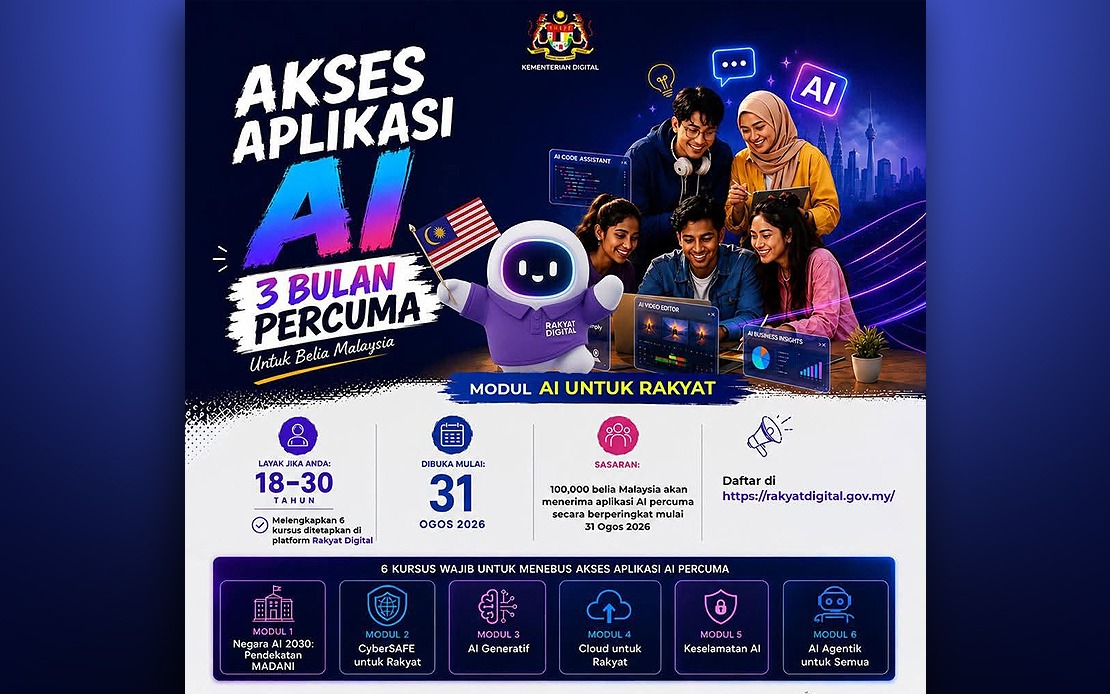
The Malaysian government is rolling out an ambitious artificial intelligence literacy programme designed to democratise access to cutting-edge technology among the nation's youth. Announced by Prime Minister Datuk Seri Anwar Ibrahim on August 30, the AI for the People initiative represents a significant commitment to building digital capacity at grassroots level, targeting 100,000 Malaysians aged between 18 and 30 through 2027. Registration opened immediately via the Rakyat Digital portal at rakyatdigital.gov.my, with the programme being implemented in phases to ensure manageable scaling and quality delivery across the country.
At the heart of the initiative lies a structured six-module curriculum designed to provide comprehensive coverage of contemporary AI concepts and practical applications. Participants must complete and successfully pass all designated coursework to unlock the full benefits of the scheme. The Digital Ministry has constructed these modules to address both foundational understanding and specialised knowledge: participants will progress through AI Nation 2030: The MADANI Approach, a framework rooted in Malaysia's development philosophy; CYBERSAFE for the People, which addresses security considerations in digital environments; Generative AI, covering the transformative technology reshaping numerous sectors; AI Security, focusing on protective measures and ethical deployment; Agentic AI for All, exploring autonomous intelligent systems; and Cloud for the People, examining distributed computing infrastructure that underpins modern AI services.
The tangible reward structure serves as a powerful incentive for engagement and completion. Those who successfully navigate the entire curriculum qualify for a three-month complimentary subscription to premium artificial intelligence applications and software, providing hands-on experience with enterprise-grade tools that would otherwise remain financially inaccessible to many young Malaysians. This transition from theoretical knowledge to practical application represents a critical pedagogical element, enabling participants to develop proficiency rather than merely conceptual understanding.
The government has secured partnerships with both established technology giants and emerging local players to provide diverse tool access. Initial participating providers include YTL AI Labs, contributing its IlmuChat platform developed with Malaysian technological expertise; Alibaba, offering Wonderclip and MuleRun through its international network; and Google, providing Gemini Enterprise to Malaysian participants. This multi-vendor approach prevents lock-in to single platforms and exposes participants to various AI ecosystems, enhancing their adaptability and career readiness across different technology environments.
The Digital Ministry has signalled its intention to progressively expand the tool suite beyond this initial offering. Additional artificial intelligence software and applications from further technology companies will be integrated in phased rollouts, continuously enriching the learning ecosystem and keeping the programme aligned with rapidly evolving industry standards. This forward-looking architecture acknowledges that AI capabilities and commercial offerings change swiftly, ensuring the programme remains relevant rather than becoming obsolete within months of launch.
Digital Ministry secretary-general Datuk Fabian Bigar emphasised the transformative potential of democratising AI access, positioning the initiative as essential infrastructure for national digital maturity. By providing youths not merely with theoretical knowledge but with genuine access to functional AI tools, the programme addresses a critical gap in Malaysian digital education. Many young people understand AI conceptually but lack opportunity to develop practical competency, a deficiency that can disadvantage them in increasingly technology-dependent employment markets across Southeast Asia and globally.
The initiative aligns closely with Malaysia's Digital 2030 aspirations and the government's stated objective of establishing an inclusive AI Nation by 2030. Rather than allowing AI advancement to concentrate benefits among affluent urbanites and technology professionals, this scheme intentionally builds capability across demographic boundaries. The focus on youth aged 18 to 30 reflects recognition that this cohort will shape Malaysia's digital future and that early intervention in their AI literacy creates compounding advantages throughout their professional trajectories.
For Malaysian youths, the programme offers practical pathways to enhance creativity, productivity, and digital capabilities essential for navigating future employment landscapes. Access to generative AI tools enables young people to explore applications in content creation, problem-solving, and entrepreneurship without upfront financial barriers. This democratisation of technological access becomes particularly significant in Malaysia's context, where regional competition for digital talent continues intensifying and neighbouring countries pursue aggressive AI adoption strategies.
The Rakyat Digital portal, administered by MyDIGITAL Corporation under Digital Ministry oversight, serves as the institutional delivery mechanism for this large-scale capability-building exercise. By centralising registration and module delivery through a dedicated government platform, authorities can track participation, monitor completion rates, and gather data on outcomes and participant satisfaction. This infrastructure-based approach enables evidence-based refinement of subsequent programme iterations.
Implementation in phases rather than attempting nationwide simultaneous launch reflects pragmatic project management. Phased deployment allows organisers to identify bottlenecks, troubleshoot technical issues, and optimise user experience before scaling to full capacity. For Malaysian participants in early cohorts, this staggered approach provides opportunity to provide feedback that shapes the experience for later registrants, creating iterative improvement dynamics.
The scale of ambition underlying this programme is notable within Southeast Asian context. Targeting 100,000 individuals represents substantial commitment of resources and institutional coordination, positioning Malaysia alongside regional leaders in recognising AI literacy as essential public infrastructure rather than luxury provision. Implementation success will likely influence similar initiatives across Southeast Asia, as other governments observe whether free, government-delivered AI training can meaningfully shift national competency distributions.
Beyond immediate participant benefits, the initiative carries broader implications for Malaysia's digital economy development. A cohort of 100,000 young people with practical AI experience becomes available to employers, startups, and innovation hubs seeking talent. This supply-side intervention in the labour market addresses structural imbalances where demand for AI-competent workers outpaces supply, potentially unlocking economic value creation across sectors from financial services to manufacturing and healthcare. The programme essentially represents an investment in human capital formation targeted at emerging technology domains.
For individuals eligible to participate, registration through rakyatdigital.gov.my represents a low-friction entry point to meaningful technology training previously unavailable through traditional educational channels. The free nature of participation removes financial barriers that often constrain skills development among middle and lower-income Malaysian families, potentially expanding the diversity of talent entering AI-related careers and contributing to more inclusive innovation ecosystems across the country.

